
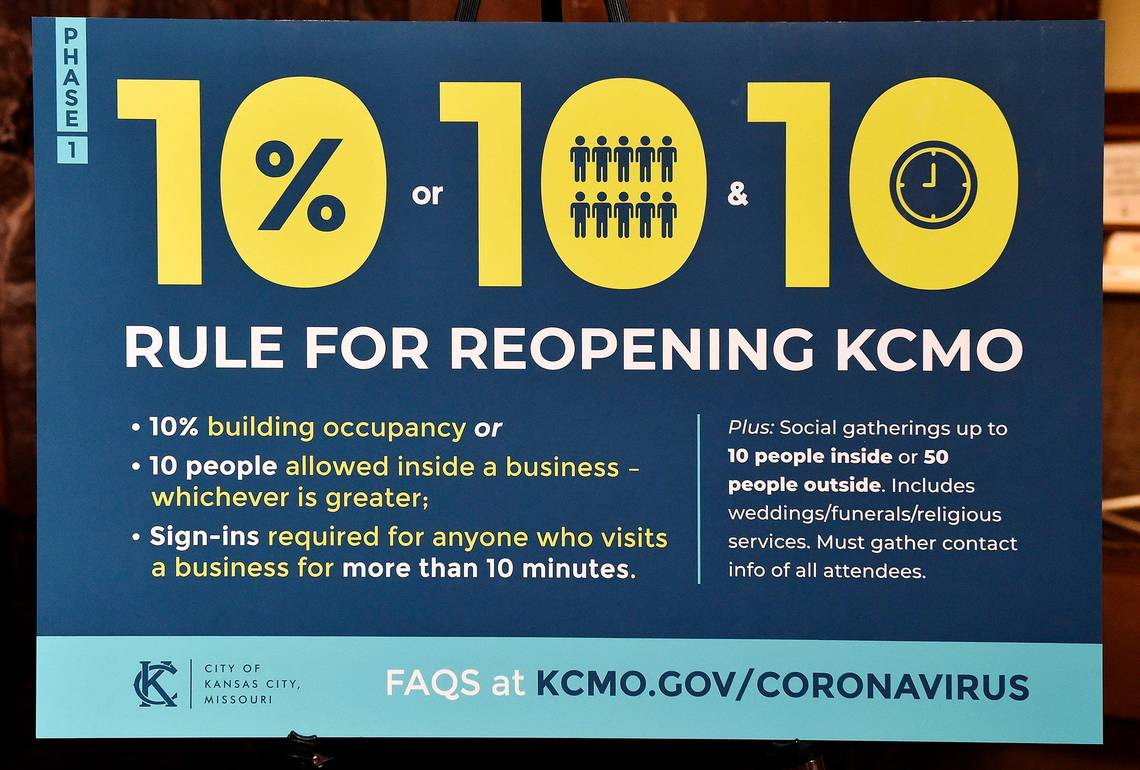
On April 29, Kansas City Mayor Quinton Lucas announced his 10-10-10 plan for reopening the city after the stay at home order ends on May 15. Since then the plan has been subject to revisions and walk-backs and now seems vague and unenforceable. City leaders could have avoided this.
The Kansas City Star reported that smaller businesses previously considered nonessential will be able to open but,
will have to follow the city’s new rules, dubbed “10-10-10,” for the foreseeable future: They must operate at 10% of their normal capacity or have 10 people in the establishment, whatever is greater. That includes the employees needed to run the business.
Businesses or gathering places with more traffic, such as restaurants, libraries, community centers and gyms, will stick to the May 15 opening date but must also follow the new rules.
The plan also requires that “customers who are in a business for more than 10 minutes will have to register their name and contact information.” The requirement of registering names caused an outcry and on May 5 city leadership reversed the rule, making registration merely a recommendation.
Even without a government mandated collection of names, restaurants cannot operate at 10 percent capacity. The mayor apparently had not consulted with restaurant owners before promulgating the plan. Restaurant owners objected, and on May 11, the Star reported that the city again retreated:
In a notice to its members Sunday night that was obtained by The Star, the Greater Kansas City Restaurant Association said it had worked with Lucas to ensure restaurants were subject to a social-distancing requirement rather than a limit on their capacity.
Under the new rules, tables must be spaced 10 feet apart and/or parties must be seated six feet apart — “as measured from back of chair to back of chair.” Workers and patrons who are exhibiting coronavirus symptoms must be turned away.
Of course, essential—and potentially crowded—businesses such as grocery stores are not subject to any parts of the 10-10-10 rule. And the list of what constitutes an essential business seem pretty broad. In his May 4 proclamation, Mayor Lucas wrote (page 5), “Essential Businesses’ include, but are not limited to, for-profit, non-profit, and educational entities, regardless of corporate or entity structure, which provide services in,” twenty-three different subcategories. This includes, “xvii. Businesses that supply other essential business with the support or supplies necessary to operate.” That seems like a pretty big loophole.
Any well-meaning business owner can and should be forgiven for running afoul of these Byzantine rules and standards. It doesn’t help that city leaders imposed impossible regulations on some businesses without bothering to consult with them first. If city leaders want their orders adhered to, they should do a better job drafting them.




