

Earlier this year, researchers from Harvard released a blockbuster study on economic mobility in the United States. The conclusion: neighborhoods matter. Where (and around whom) you grow up has long-term effects on your earnings and your quality of life.
The researchers partnered with The New York Times to create a searchable data visualization of every county in America and its neighborhood effect on lifetime earnings. Missouri is shown below (on the map, blue is good and red is bad.)
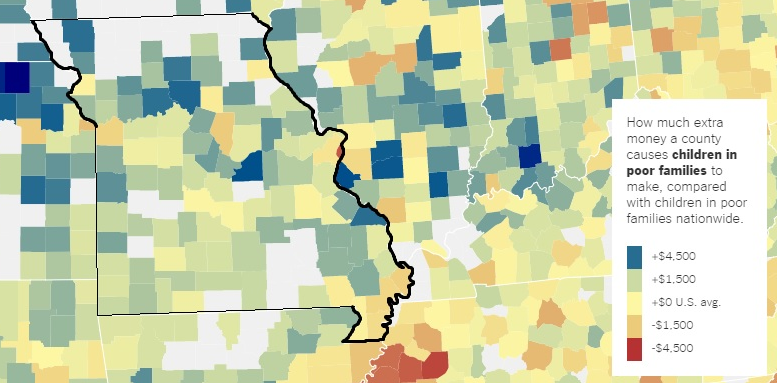
The three best counties to grow up in, paired with the extra money a child from a poor family will expect to make by age 26 for having grown up there, are:
- Osage County +$5,260
- Chariton County +$4,660
- Perry County $4,460
The three worst counties, paired with the negative financial repercussion of growing up there, are:
- St. Louis City –$3,780
- Boone County –$1,470
- Mississippi County –$1,320
The authors point to five factors driving better rates of upward mobility: less segregation by income and race, lower levels of economic inequality, better schools, lower rates of violent crime, and a larger share of two-parent households.
Each of those factors is important, but here I’d like to focus on the role that educational attainment plays in increasing economic mobility. Take a look at this graph from the Pew Research Center:
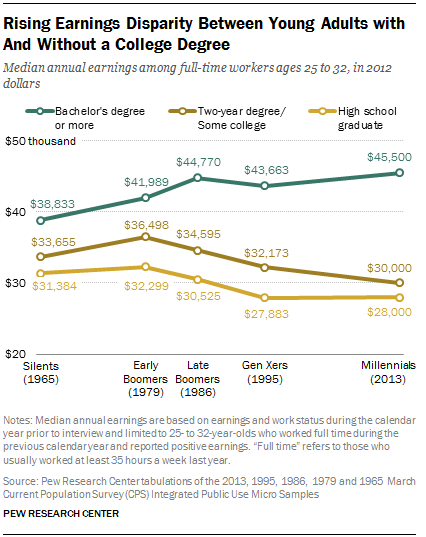
The gap between the wages of high school graduates and college graduates is widening. Helping more students successfully complete high school and then get a meaningful postsecondary credential (it doesn’t have to be a four-year degree, but it’s critical to choose one’s field of study wisely) can be a huge boost to upward mobility. Consider the following graph from the Brookings Institution’s Hamilton Project:
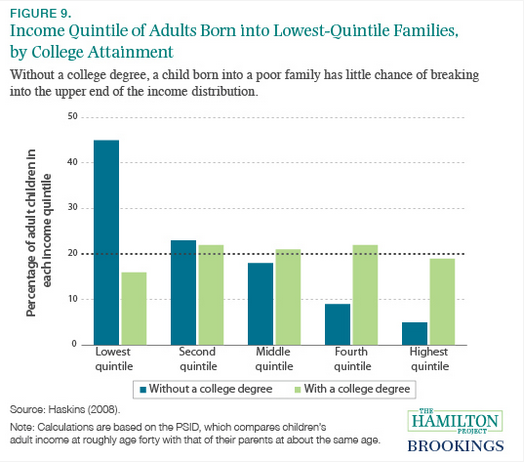
Visually, what jumps out are the dark bars, which show how difficult it is to progress to a better economic situation without a college degree. But the light bars tell a much more hopeful (and frankly amazing) story. At the far right edge of the graph we see that with a college degree, even someone born into a poor family has a 19% chance of making it into the top quintile of income distribution. By definition, only 20% of the entire population is in that top quintile at any given time, so this finding suggests that those who earn a college degree in spite of the formidable challenges of poverty really do achieve economic mobility.
The problem is that so few among the economically disadvantaged are able to earn that college degree. Several factors—broken families, lackluster schools, and unsafe streets, to name a few—contribute to opportunity inequality that is too often overlooked by those who consider income inequality to be the primary (or even the only) concern. But rather than hold out for a single solution to all of these interconnected problems, why not see if serious educational reform (as Show-Me Institute writers have suggested here and here and here, for example) can help give students the opportunities they need to improve their lives?




