
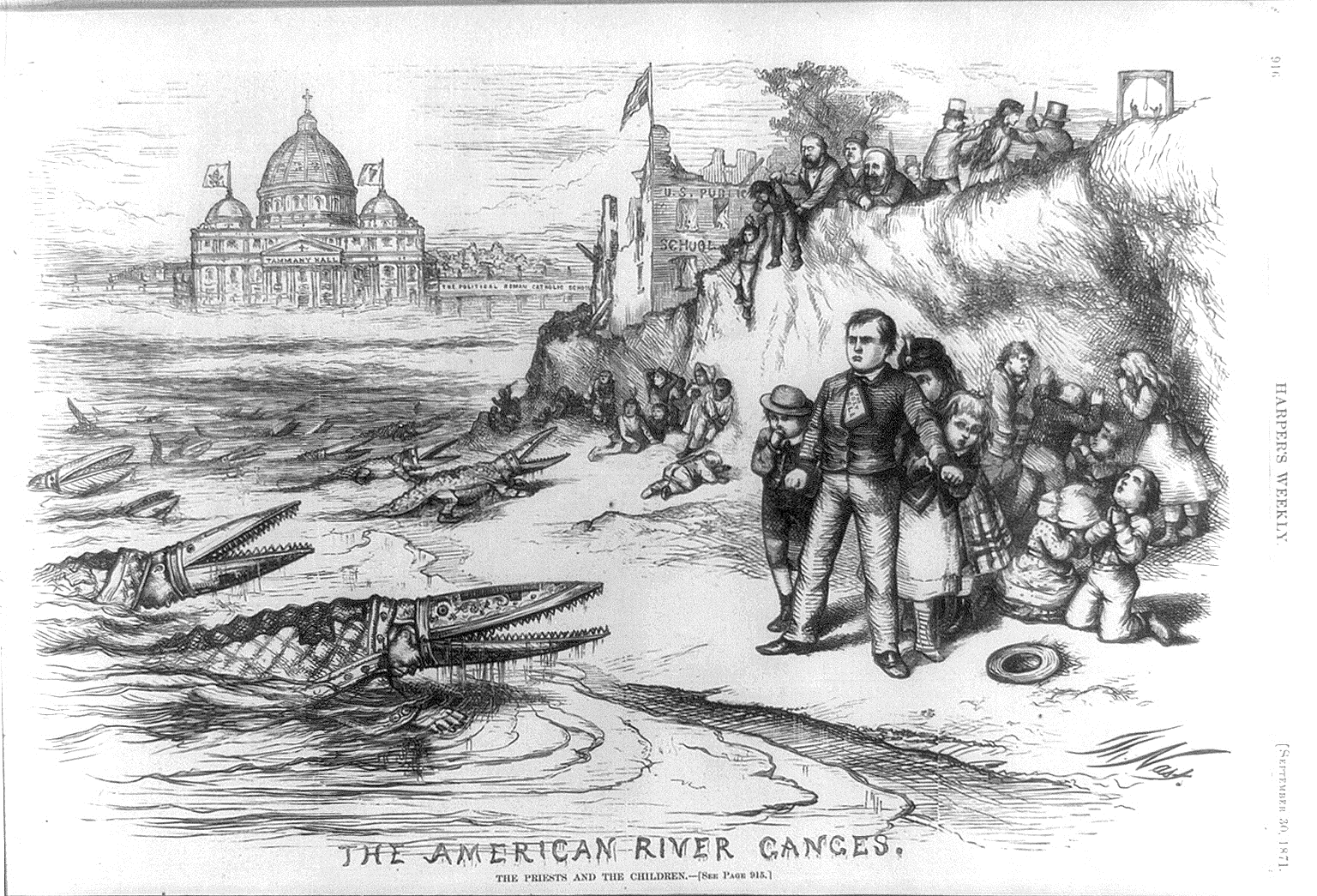
Yesterday I wrote about a Supreme Court case out of Missouri challenging the state’s Blaine Amendment. This case could have far-reaching consequences for school choice, as it would allow more students to have access to vouchers or education savings accounts in states where Blaine Amendments currently prohibit them.
But I wanted to take a moment and dig into the historical origins of Blaine Amendments. Specifically, why was James G. Blaine so interested in amending the Constitution? Was he a crusader for the separation of church and state?
To save you the runaround, the answer is no. At best, he and his compatriots were political opportunists who saw alienating Catholics as a winning political strategy in the age of Know-Nothingism. At worst, he was an anti-Catholic bigot. The “sect” that he was referring to was Catholicism. Don’t believe me? Look closely at the famous Thomas Nast cartoon (above) from the era. Yes, those alligators are bishops, the capitol is the Vatican, the public school is under siege, and a teacher is being led to the gallows. Not our nation’s finest hour.
Ultimately, Blaine’s anti-Catholicism torpedoed his quest for the presidency. At a rally just weeks before the election of 1884, where Blaine was the Republican candidate, a speaker derided Democrats as being the party of “Rum, Romanism, and Rebellion,” invigorating the Catholics of New York and elsewhere to come out in force against Blaine and narrowly elect Grover Cleveland.
So this is really the question before the Supreme Court, and the people of Missouri: Are we still afraid of rum, Romanism, and rebellion?
Personally, I’m a big supporter of the separation of church and state. I don’t want to see a state religion. At all. At the same time, I believe that the education of children or the use of playgrounds can be provided by a religious organization, subsidized by public dollars administered on a religiously neutral basis, without fear that it will establish a state church. We let people take Pell Grants or the GI Bill to SLU. We let Medicaid patients get care at Missouri Baptist Hospital. No state religion yet. It’s not clear to me why in 2016 K-12 education should be peculiarly sacrosanct.
I hope that the Supreme Court closes this sad chapter in American history and puts Blaine Amendments in the grave. Educational opportunities for millions of children hang in the balance.