
Kansas City, Death and Taxes

Economy |
By Patrick Tuohey | Read Time 2 minutes minutes

At a recent gathering of religious leaders, one earnings-tax supporter told those gathered that if the earnings tax is defeated on April 5, "We're going to lose 800 cops over 10 years." Of course there is no way that any city leadership would allow that to happen, but this is the sort of scare tactic the city is relying on to get "yes" votes.

The speaker also talked about the history of the tax, claiming that it was promulgated to increase public safety spending in response to the high murder rates in the late 1960s. We looked up the murder statistics for Kansas City, and indeed there was an increase in the late 1960s, peaking at 134 homicides in 1970. The number decreased afterward, but never returned to its previous rate. The speaker offered no evidence to support the idea that the imposition of a regressive flat tax had anything to do with declining murder rates. He certainly offered nothing to suggest that phasing out the earnings tax now would lead to an increase in homicides. The tactic seems intent not on educating voters, but on frightening them.

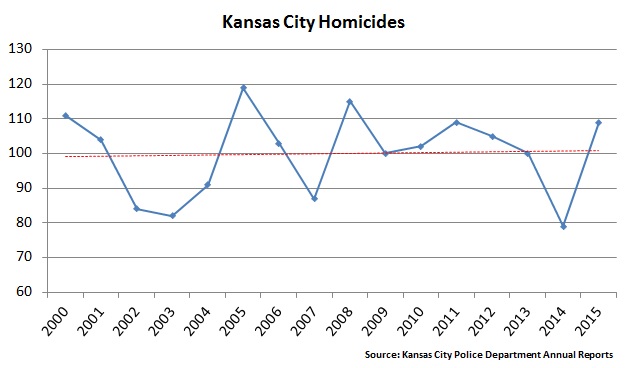
Are things better now? Over the last few years, Kansas City has averaged 101 murders each year, and the trend is pretty flat since 2000. Overall, Kansas City has one of the highest murder rates in the United States, and while national data for 2015 are not yet available, the jump in homicides in 2014 may return us to the top ten, where we were in 2013

Back in the 1960s, Kansas City had a high murder rate. Today we have a high murder rate and an earnings tax. Is this the type of "progress" of which Kansas Citians can be proud?

About the Author

Patrick Tuohey is a senior fellow at the Show-Me Institute and co-founder and policy director of the Better Cities Project. Both organizations aim to deliver the best in public policy research from around the country to local leaders, communities and voters. He works to foster understanding of the consequences — often unintended — of policies regarding economic development, taxation, education, policing, and transportation. In 2021, Patrick served as a fellow of the Robert J. Dole Institute of Politics at the University of Kansas. He is currently a visiting fellow at the Yorktown Foundation for Public Policy in Virginia and also a regular opinion columnist for The Kansas City Star. Previously, Patrick served as the director of municipal policy at the Show-Me Institute. Patrick’s essays have been published widely in print and online including in newspapers around the country, The Hill, and Reason Magazine. His essays on economic development, education, and policing have been published in the three most recent editions of the Greater Kansas City Urban League’s “State of Black Kansas City.” Patrick’s work on the intersection of those topics spurred parents and activists to oppose economic development incentive projects where they are not needed and was a contributing factor in the KCPT documentary, “Our Divided City” about crime, urban blight, and public policy in Kansas City. Patrick received a bachelor’s degree from Boston College in 1993.

Similar Stories

Support Us

Headline to go here about the good with supporting us.

Donate
Man on Horse Charging