

Does more education help predict higher future income? In a study to be published by the Show-Me Institute, my co-author, Gail Heyne Hafer, and I compare educational attainment by adults 25 years ago to median family incomes in 2015 across all Missouri counties. What we find is that, yes, past education is a good predictor of future income.
To illustrate the education–income relationship we use scatter plots, reproduced below. Each dot represents a county in Missouri. Let us explain how each county is located in the plot. Each county’s value (income or education) is measured relative to the state average. If a county’s median income is equal to the state average, its median income value in the plot is 1.0. If the county’s median income is less than the state average, its median income value is less than 1.0; if it is greater than the state average, its value is larger than 1.0. A similar technique is used to measure educational attainment across counties. The combination of a county’s relative median income and relative educational attainment value locates it on the scatter plot. If a county is just like the state average on both measures, it would be located at the intersection of the black lines. The vertical axis is county median family income relative to the state average in 2015. The horizontal axis is one of two education measures in 1990, again relative to the state average.
Two measures of educational attainment are used. In the top scatter plot, education is measured as the percent of adults with no high school diploma: In effect, someone who got no more than a high school education. In the second panel educational attainment is measured by adults in each county who graduated from high school and obtained some college. “Some college” is two or fewer years, which can occur at a four-year college, community college, or at technical school. By comparing the outcomes using these two education measures, what we are asking is whether counties that have more adults with educational beyond high school in 1990 are counties that generally have higher median family incomes in 2015. Does education matter for future income?
Comparing current median family incomes across these two educational outcomes shows that the average county with a higher proportion of adults who in 1990 did not finish high school (upper panel) is likely to have a lower median income today relative to the state. That relationship flips when education is extended to include some college (lower panel). The positive slant of the dots in the lower panel means that if in 1990 a county had a higher proportion of adults who had obtained some college training it is more likely that in 2015 median family income in that county is higher than the state average.
The relationships illustrated below support for policies aimed at raising educational attainment. Completing high school is important. It may be even more important economically to extend that preparation to include some post-high school training. At a minimum, policymakers should understand the positive long-term implications of funding post-secondary education.
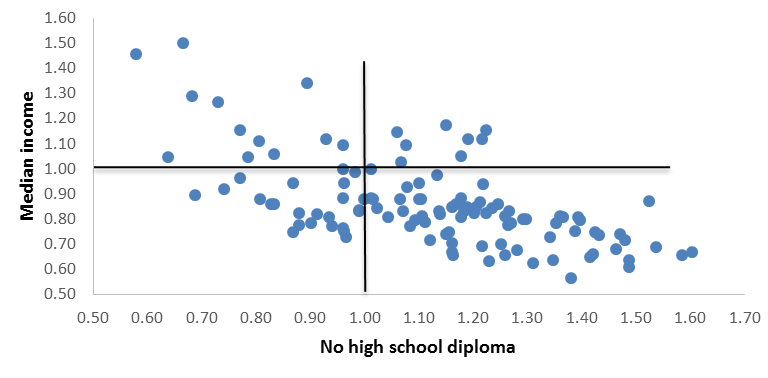
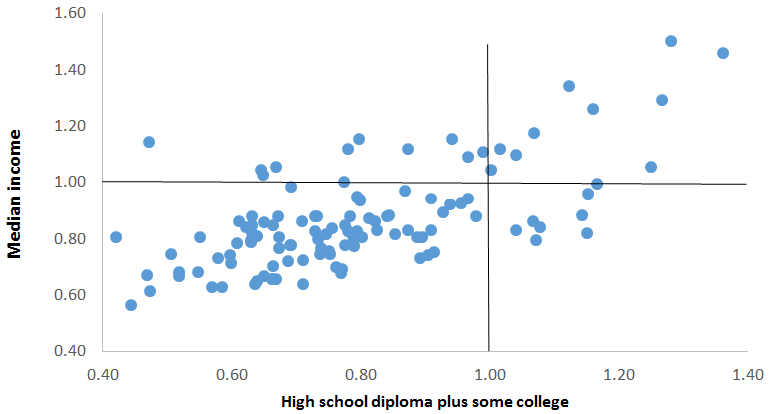
Note: Each dot represents a Missouri county. The axes compare county values to the state average. If a county’s median income is equal to the state average, its median income value is 1.0. If the county’s median income is less than the state average, its median income value is less than 1.0; if it is greater than the state average, its value is larger than 1.0. A similar technique is used to measure educational attainment across counties. The combination of a county’s relative median income and relative educational attainment value locates it on the scatter plot.