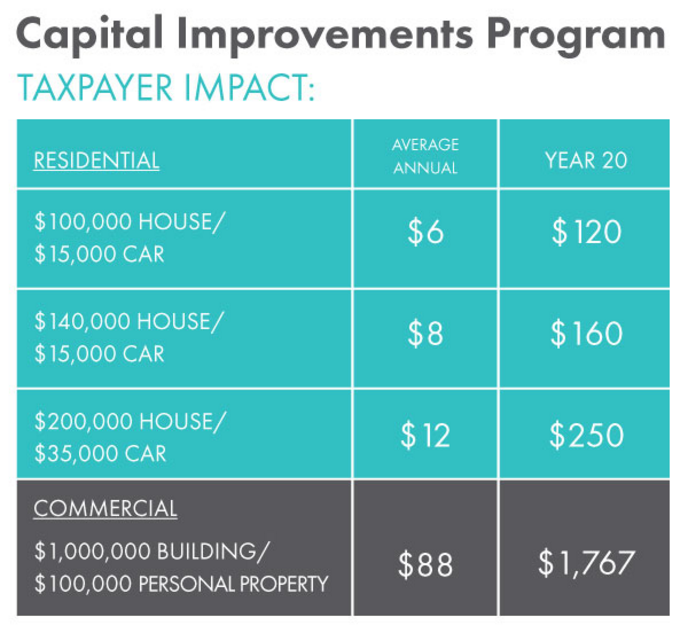
In my recent post, The GO Bonds Will Cost You Much More Than You’re Being Told, I concluded that—contrary to claims on the city’s website—the total amount of taxes paid for the GO bond would be $2,400 over the life of the bond for someone with a $100,000 house and a $15,000 car. But this was wrong. It turns out that I underestimated the total impact of the GO bond tax. It is actually over $4,100. My initial estimate was wrong because I did not have the city’s assumptions in front of me. Now that I do have the assumptions, they bring no comfort.
In my previous post, I relied on the information made available on the city’s website, but I could not duplicate the city’s claim that the “average annual” cost was only $8 for someone who owned a $140,000 house and a $15,000 car. I incorrectly concluded that the city must be talking about only one of the 20-year bonds. The city’s Deputy Finance Department Director pointed out my errors and provided me their assumptions in the spreadsheet attached here.
In short, the $8 shown in the “Average Annual” column is the average annual increase in city property taxes, not merely the “average annual” impact of the bonds that the website presents The city’s website makes no mention of this, but those increases are cumulative. The city’s own data shows a GO bond tax increase on the $140,000 home/$15,000 car of $13.67 in fiscal year 2018. The following year it will be $26.95, then 39.62 and $52.32 in fiscal years 2020 and 2021. These figures represent the genuine cost of the GO bonds.
To get to the $8 figure, the city factors in the retirement of other bonds that will be paid off during the life of the GO bond. Those issues are independent of the matter in front of voters on April 4 and ought not be considered. The $8 figure also assumes that the city will not issue any new special or general obligation bonds until the year 2056. How seriously can we take projections based on the assumption that Kansas City won’t issue any more bonds over the next 40 years?
To keep things simple, I calculated the GO bond impact to taxpayers independent of other bonds that would expire or that might be issued. Using the city’s own assumptions on interest and growth in assessed value, the total additional tax paid for a $140,000 home and $15,000 car is $4,152.98 over the life of the bonds. The property tax increase called for in this GO bond will start at $13.68 in FY2018, gradually climb to a peak of $206.13 in FY2037, and then decrease to $7.77 in FY2056.
I wish these assumptions were made available by the city on its website. But now we know: the GO bonds will cost much more than we’re being told. And the way in which the city arrives at its own estimate of the cost to taxpayers is less than transparent.