

When?Janus vs. AFSCME?was decided earlier this summer, its immediate effect was on the 22 states that allowed government unions to collect agency fees from workers. Thanks to?Janus, those government workers can no longer be compelled to support a union as a condition of employment. But fortunately, workers in Missouri had those rights already by statute, namely Missouri Revised Statute §105.510. That section makes clear a number of things, but relevant to the agency fee discussion?is this?(emphasis mine):
No such employee shall be discharged or discriminated against because of his exercise of such right [to form and join a union],?nor shall any person or group of persons, directly or indirectly, by intimidation or coercion, compel or attempt to compel any such employee to join or refrain from joining a labor organization.
Which brings me to a research project that we have recently embarked upon: to catalogue and review the collective bargaining agreements (CBAs) that have been instituted by the state, and by local governments across the state.?The Show-Me CBAs Project?is still in its early stages, but it has been remarkable to see how often agency fee requirements are included in these contracts.
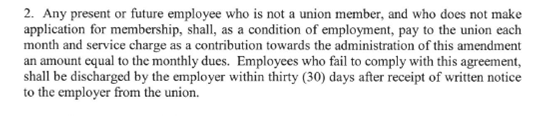
For instance, Crystal City in Jefferson County appears to have amended an existing agreement on March 26 of this year to add a provision requiring employees to pay and become union members, to pay the union the amount of union dues but not be a member, or be fired.?Page 13:
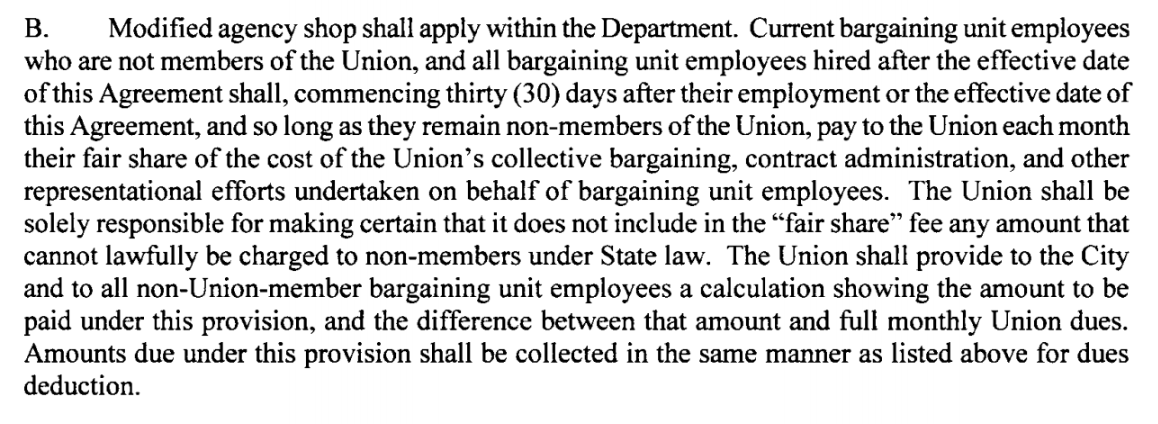
Meanwhile in a contract agreed to this past June, the City of Grandview also included in its contract with Grandview Firefighters, Local No. 42, a provision compelling non–union members to support the union’s activities through a “modified agency shop.” Page 2 of the agreement:
Curiously, both Crystal City and Grandview struck their respective agency fee sections shortly after we contacted them about their collective bargaining agreements. On the same day that we contacted Grandview (July 24) requesting its collective bargaining agreements, the Grandview Board of Aldermen removed the offending section by ordinance. We also contacted Crystal City on July 24; and on August 13, its agency fee section was removed.
While the removal of these sections was appropriate, the larger problem here is that it appears these local governments (and many others) may have been violating of Missouri workers’ rights even before the?Janus?decision was handed down. When a contract the city negotiates purports to give the union power over you, and especially when you aren’t given reasonable notice of your actual employment rights, hasn’t the city, through its CBA, “directly or indirectly” attempted to compel you to join a labor organization, in violation of the plain language of §105.510 of the Missouri Statutes? Moreover, if any of these cities exercised a termination provision of one of these agreements against an employee—if they fired someone (or formally threatened to fire him) because he didn’t pay the union as a condition to employment—then the statutory violation seems even more obvious.
In Missouri, these provisions shouldn’t have been in these contracts even prior to?Janus, as they were already contrary to existing state statute. Local governments should be very concerned about whether past and current employees—all workers, both union and non-union, who made decisions based on such language—will want back the dues and fees taken under a CBA regime that misled them about their rights under Missouri law.




