

Kelly Clarkson says that what doesn’t kill you makes you stronger, and I believe her. You know who doesn’t believe her? Teachers who are willing to close down the schools in their state to prevent any student from having a choice when it comes to their education. Rather than adapting to charter school competition and becoming stronger in the process, some try to just kill charter schools outright. West Virginia teachers attempted this recently, and it worked. The threat of seven potential charter schools opening in their state was killed, even though the teachers would have received raises from the same bill.
As a researcher, I can’t stress enough that correlation doesn’t equal causation, but I’m still struck by the following graphic.
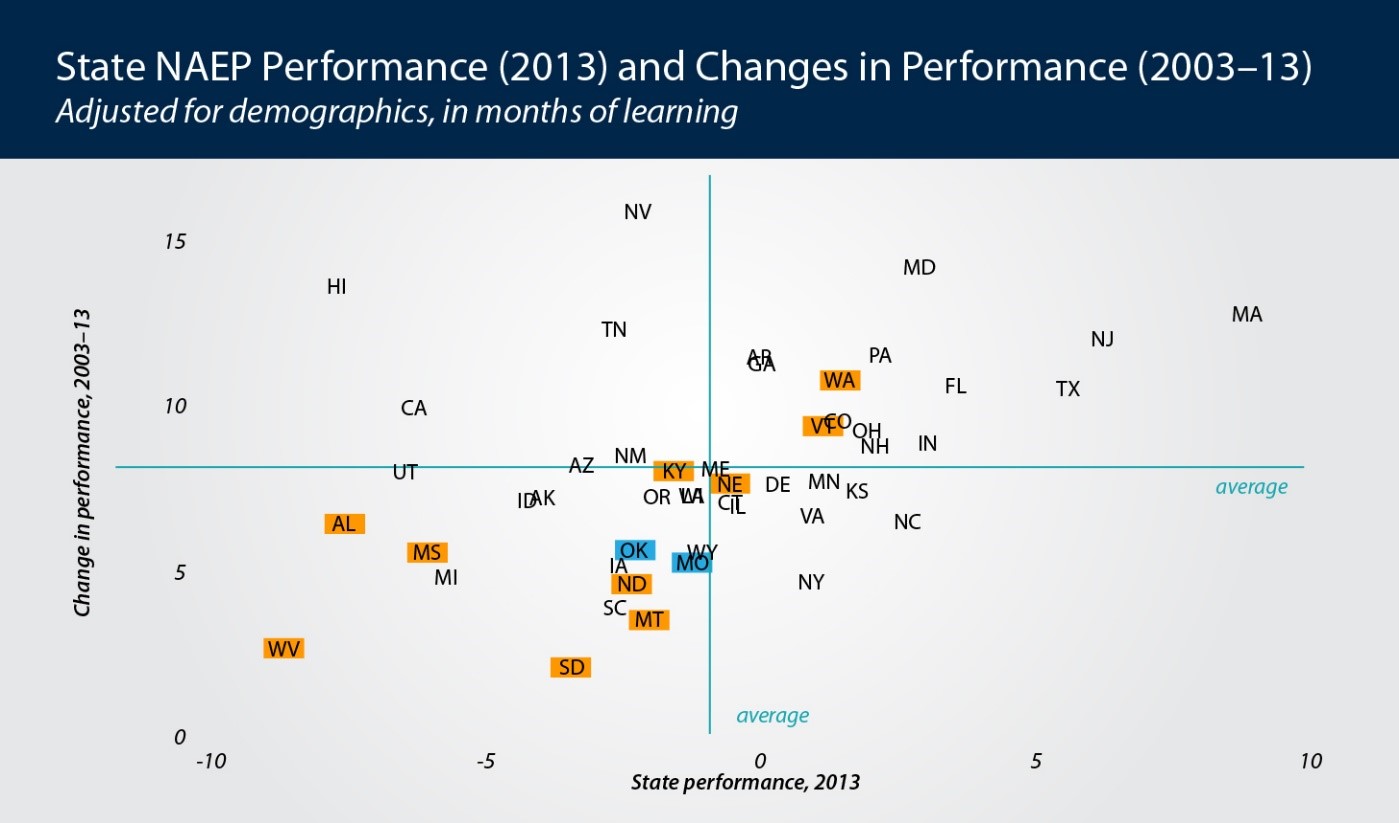
This graphic was created by the Urban Institute for their 2015 report, Breaking the Curve: Promises and Pitfalls of Using NAEP Data to Assess the State Role in Student Achievement. The states in the bottom left quadrant are those that both performed in the bottom half of all states on National Assessment of Educational Progress (NAEP) in 2013, and also saw their NAEP scores decline between 2003 and 2013, after controlling for student demographics. And the states in this bottom left quadrant are mostly states with little or no school choice. The states in orange had no charter schools in 2013, and those in blue only allowed charter schools as punishment for low performance. Oklahoma gave up using charters as a last resort for low-performing districts in 2015, but Missouri has not. Iowa and Wyoming had fewer than 400 students in charter schools in 2013. By contrast, Florida and Texas had over 200,000 students enrolled in charter schools that same year. Pennsylvania had almost 120,000 charter school students and New Jersey and Massachusetts had about 30,000 each.
If school choice killed public education, this graphic would look a lot different. I’m perplexed that the states in the bottom left quadrant, including Missouri, think that taking a strong stance against school choice is a winning strategy.




