
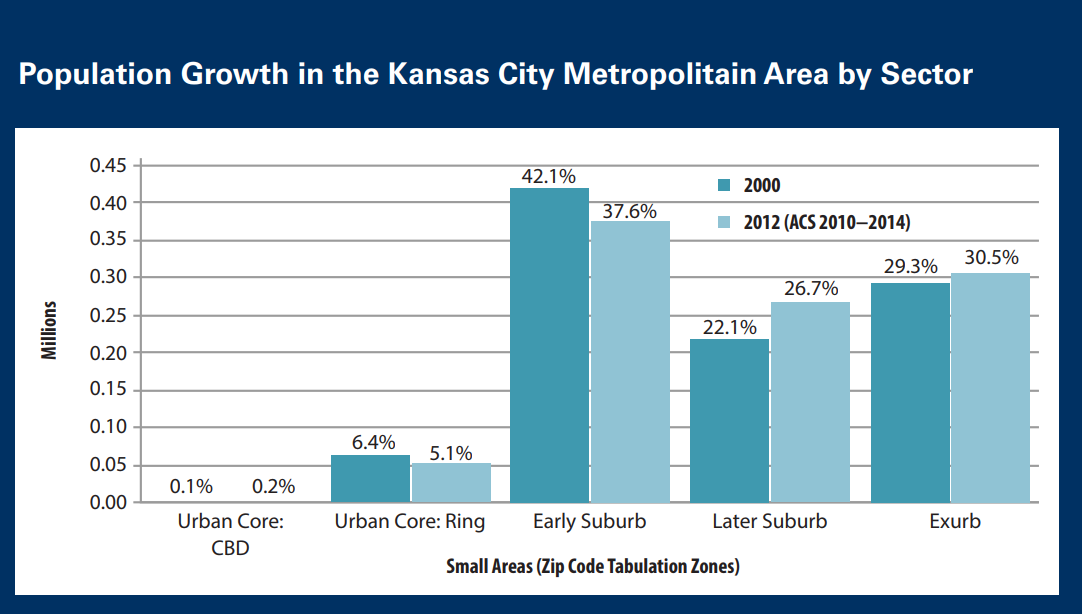
The other day we published a post about some Brookings Institution data suggesting the Kansas City was doing well with millennials. The data was not specific to Kansas City, Missouri but rather the entire 14-county metropolitan area. There is reason to think that outer areas such as Olathe and Overland Park are doing well attracting millennials, but what about Kansas City proper? After all, the city has spent “hundreds of millions of dollars downtown, probably in excess of a billion” to attract millennials and others. Is it working?
The author of the Brookings Institution study referenced above does not know about Kansas City proper, or more specifically about downtown Kansas City. The Downtown Council itself apparently can’t provide worthwhile numbers either. Trying to piece together the data requires investing a lot of time and resources going through Census data at the county level. Until someone does that in 2019, we can rely on a 2016 paper for the Show-Me Institute by Wendell Cox, “Kansas City—Genuinely World Class.”
In Figure 3 on page 6, Cox offers us the chart at the top of this post. As you can see, populations have not grown in the urban parts of the Kansas City but rather in the areas outside the city proper. In fact, the urban and near-in suburbs are shrinking. This is expected to continue. Cox writes:
According to the Mid-America Regional Council, population growth will continue to be concentrated in the suburban counties. Between 2010 and 2040, it is projected that approximately 45 percent of the population growth will be in Johnson County, which will make up the bulk of the 55 percent of metropolitan area growth that is projected to occur in the Kansas suburbs. The Missouri counties are projected to constitute 45 percent of the metropolitan area growth, with Cass County accounting for 18 percent and Jackson County for 11 percent (Figure 4).
Lots of organizations spend a lot of money trying to attract people and jobs to Kansas City. All them have an incentive to show that all that money—in many cases tax dollars—is well spent so that their budgets will be expanded. Successes seem rare and the data aren’t promising. But if city leaders are serious about attracting residents and jobs, we need to have a serious conversation about what is working and what is not.




