
If there is an affordable housing shortage in Kansas City, why is that so? Could the very housing policies meant to help actually be part of the problem? No less than Bob Langenkamp, the man formerly in charge of handing out economic development subsidies in Kansas City, said these subsidies were necessary to offset the increased costs of city regulation. This stayed with me because I suspect he is exactly right, and it occurs to me again as Kansas City contemplates policies to encourage more affordable housing construction. Rather than increase costs and then offer subsidies, the city ought to be reducing costs and staying out of the way.
Some were quick to argue last year that the greatest threat to affordable housing is the ending of low- income housing tax credits (LIHTC). This is demonstrably wrong. The program was fully funded up through the end of 2017; any current affordable housing shortage in Kansas City has nothing to do with a lack of state tax credits. And the data from the Missouri Housing Development Commission show that the number of housing units in the construction pipeline has not decreased since state funding for LIHTC was zeroed-out.
The simple problem in Kansas City, St. Louis and elsewhere is in part due to the high cost of housing regulations and city bureaucracy; it is simply too expensive to build so-called affordable housing.
A 2018 paper issued by the National Association of Homebuilders (NAHB) and National Multifamily Housing Council (NMHC) concludes that:
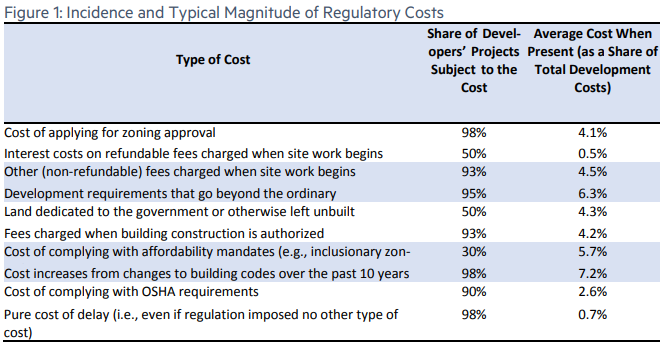
Regulation imposed by all levels of government accounts for an average of 32.1 percent of multifamily development costs, according to new research released today by the National Association of Home Builders (NAHB) and the National Multifamily Housing Council (NMHC). In fact, in a quarter of cases, that number can reach as high as 42.6 percent.
The table at the top of this post shows the impact on housing costs of several types of government-imposed costs such as changes in building codes or requirements over and above common standards. The NAHB paper goes on to say: “Over 90 percent of multifamily developers also incur costs of delays caused by sometimes lengthy approval processes.”
A study released in 2016 concluded: “. . . on average, regulations imposed by government at all levels account for 24.3 percent of the final price of a new single-family home built for sale.”
Sometimes, exactly because the government is trying to help solve a problem, the problem becomes worse. Seattle for Growth, née Smart Growth Seattle, published in 2015:
Affordable housing projects have many unique costs, and often cost more because of financing, construction, and labor requirements. Affordable housing projects can be more expensive than market-rate due to some of these unique costs.
Regulations regarding health and safety are necessary, and one does not need to argue that housing construction should go unregulated to suggest that some obstacles are not worth the expense. Some of these obstacles, such as time spent waiting on permits and approvals may simply be due to city offices being overworked and understaffed. Cities ought to understand the barriers to housing construction and the additional costs of regulation before they act to add even more regulation or spend limited tax dollars on subsidies.




