

If you’re following the presidential primaries, you might think that everyone has decided that school choice isn’t cool anymore. That’s confusing because choosing your child’s kindergarten seems just about as important as choosing their preschool or their doctor. Nonetheless, we’re heading back to the idea that once a child turns five, the best thing to do is to turn them over to a public education system that will decide where and how they will be educated. Any choice would be limited to those parents who can move to the district they want.
Politicians are willing to directly contradict themselves to go along with this nonsense and get the support of teachers’ unions. But here’s the problem with that rhetoric—most people disagree. EdChoice has been conducting a nationally representative survey on schooling in America since 2013. Here’s what respondents think about school choice.
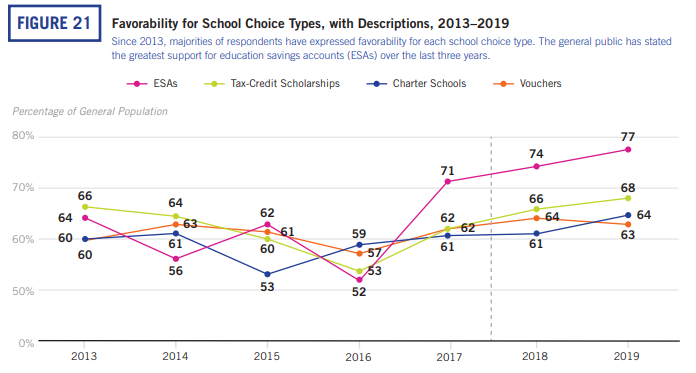
Even though there was a brief decline in approval a few years ago, the takeaway remains—the general population of the United States favors school choice. And it’s ridiculous to think that Missourians are somehow not aligned with everyone else. ESAs seem to be appealing, given that 77 percent of the general population view them favorably. Here’s the description given to EdChoice survey respondents:
An “education savings account” in K-12 education – often called an ESA – establishes for parents a government-authorized savings account with restricted, but multiple uses for educational purposes. Parents can then use these funds to pay for: school tuition, tutoring, online education programs, therapies for students with special needs, textbooks or other instructional materials, or future college expenses.
Maybe the favorability numbers for this type of program are due to the broad description of how ESA funds can be spent by parents. But make no mistake—Missouri parents can’t take advantage of any of these opportunities because Missouri has no ESAs. The Missouri legislature wasn’t even willing to fund the one ESA program it had established for students with special needs.
I’m optimistic that the disconnect between rhetoric and reality can only last for so long. Teachers’ unions may have a lot of power over politicians, but parents can be a powerful group too when they want something. Missouri parents are no exception.




