

In an incredibly shameless move, the Missouri Department of Elementary and Secondary Education (DESE) has submitted a budget request for 2025 that raises the dollar amount per student in the foundation formula because the number of public school students is declining. Apparently, the most important thing is to make sure districts don’t get less money when their enrollment is declining.
DESE and the state board of education would have you believe that the pandemic has led Missouri families to simply keep their kids at home—just like the parents who are working remotely. That, they say, is the culprit. Incorrect. I have been making this point routinely over the past year. Missouri, as a state, has declining enrollment. Actually, K-12 enrollment is declining at the national level as well.
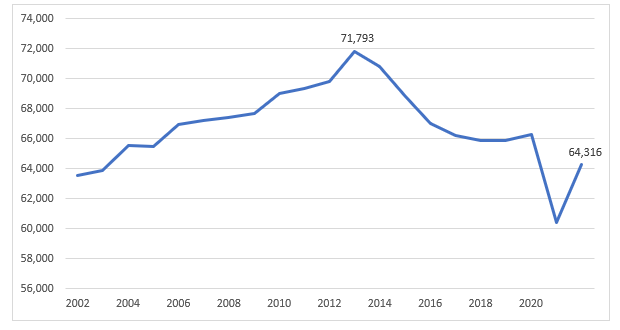
If you look at the following graph of the number of Missouri public school kindergartners each year, you can see that, after growing for a decade or so, enrollment peaked in 2013. Since then, pandemics notwithstanding, cohorts have been getting smaller and smaller. That peak is now in high school. Within a few years, the number of our high school graduates will begin a steady decline.
Missouri kindergarten enrollment: 2002–2022
If we take the position that this is a temporary problem and we manipulate the formula to make sure that overall funding stays the same (DESE actually asked for a $100M increase), we will be misappropriating taxpayer dollars. We need to fund the schools and students we have, not the schools and students we used to have.




