

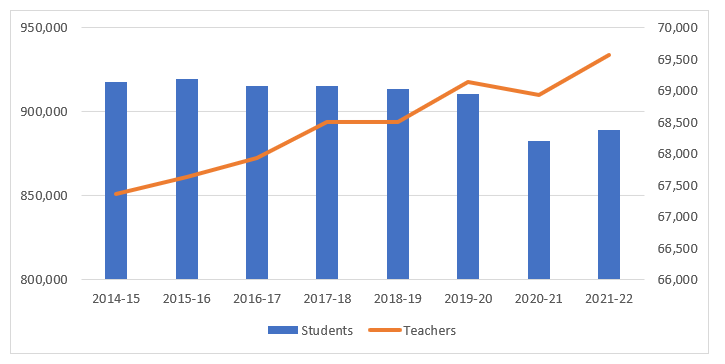
The media is finally catching on to a trend I’ve discussed often here. The number of elementary and secondary students is declining and has been declining since well before the pandemic. Meanwhile, the number of elementary and secondary teachers only grows. This trend is alive and well in Missouri, as seen in the graph below:
Missouri Elementary and Secondary Enrollment and Teachers: 2014–15 through 2021–22
Source: U.S. Department of Education, National Center for Education Statistics (NCES), Common Core of Data, Nonfiscal Survey, multiple years, nces.ed.gov/ccd
Missouri enrollment fell from 920,000 students in 2015 to 910,000 in 2019—before the pandemic. Even with the post-pandemic recovery, enrollment is still down over 30,000 students from six years ago. Interestingly, we now have over 3,000 more teachers to serve the smaller student body.
According to Dr. Marguerite Roza of Georgetown University, there have been three waves contributing to the growing teaching staff. The first was the post-recession hiring back of laid off teachers. Then there were seven boom years of growth in education funding (though not in enrollment). Finally, there has been the enormous influx of pandemic stimulus funds from the federal government.
Stimulus money is drying up, though. So, what happens next? The Department of Elementary and Secondary Education (DESE) has just submitted a budget request that has a $300 million increase. In a logic-defying move, DESE claims that fewer students means we need a higher dollar amount per student in the foundation formula. Why? Because hiring when enrollment goes down because you’ve got the money doesn’t mean you can simply fire excess teachers when the funds dry up. Public education employment contracts don’t work that way. The system needs total funding to stay the same or increase, regardless of enrollment trends. Here’s hoping the state legislature looks at the math before agreeing to this request for no accountability.