
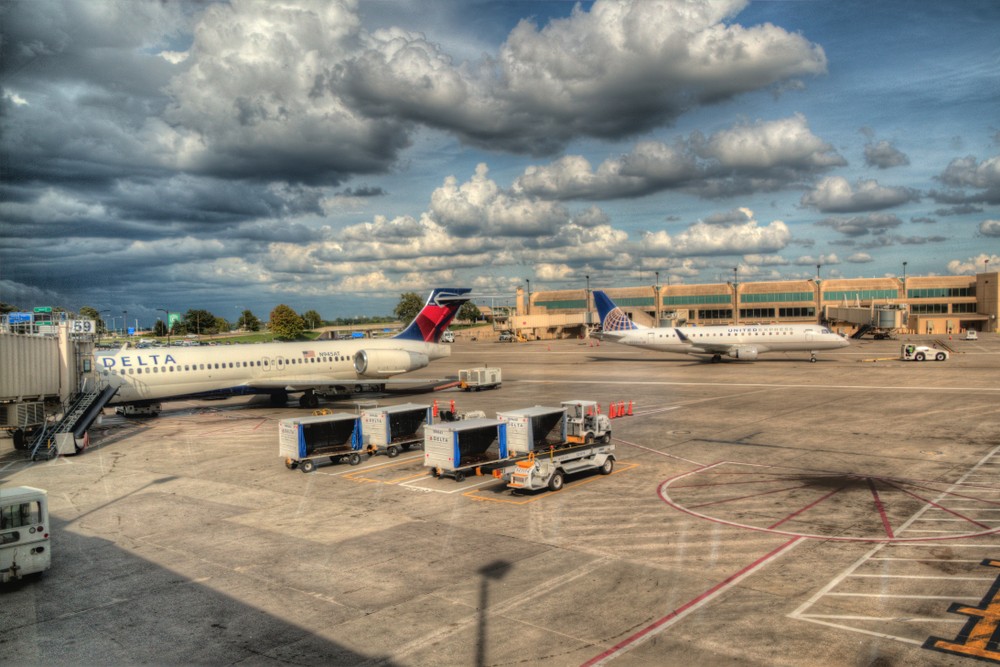
At the March 19 panel discussion of the new stadium sales tax hosted by Kansas City PBS and the Kansas City library (available online here), former mayor Sly James interjected a complete non-sequitur. He said, in an attempt to impugn my analysis of the stadium tax: “There were a lot of things said about the airport, too. One of the things that Mr. Tuohey said about the airport was that it would be fewer flights, the exact opposite has happened. There’s more flights all the time.”
I have not written anything about the Kansas City airport in years, and I doubt I would have ever predicted flight numbers. I responded in the moment that I was writing about the number of gates at the new airport. But after the event Mayor James insisted I had written such a thing. I thanked him for reading the Show-Me Institute blog and didn’t think of it again.
The very next night, I was speaking to a community group in south Kansas City about the stadium tax. In the parking lot after the event, the representative of the Royals also mentioned my KCI flight prediction when I was speaking with him—which had not come up in the meeting.
Why are members of the Royals campaign sharing Show-Me Institute blog posts from 8 years ago? And which posts? There are many. (Here is a summary of the airport debate from 2017.) Were they referring to my post from 2017 pointing out that The Kansas City Star editorial board incorrectly asserted that a new airport will guarantee more flights? Or maybe it was the one from 2016 in which I wrote:
To sum it up, the airlines (and common sense) say that building an expensive new terminal will not increase demand for air travel. Quite the contrary, the higher costs to airlines and passengers may mean fewer flights.
Neither the former mayor nor the Royals representative mentioned a specific post, but it doesn’t matter. According to the Kansas City Aviation Department’s 2023 Annual Report, there were 5,195,871 enplanements (the number of people boarding the plane) in 2023. Compared to 5,951,776 in 2019, that represents about a 14 percent drop.
What about flights? Again, using Kansas City Aviation Department data, in January 2020, right before the beginning of the pandemic, the airport saw 8,606 carrier flights in and out of the old terminals. In January 2024, there were 8,138 carrier flights. That amounts to a 10 percent drop. The change between December 2019 and December 2023 is less dramatic, but still down a half percent. Mind you, this is after the International Air Transport Association (IATA) claimed in October 2023 that air travel demand is back to pre-pandemic levels.
Claiming that flights are up at KCI is incorrect. Even if the number of flights had increased, there is a lot more at play than just a new terminal. But then, these are the same guys who argue downtown baseball has positive economic impacts. It doesn’t.




