

What Fiscal Cliff?

Education |
By Susan Pendergrass | Read Time 2 minutes minutes

Data on teachers and staff show that the number of public school district employees hit an all-time high last year, even as enrollment was down and federal funds are about to dry up. An analysis by Chad Aldeman at The 74 includes an interactive map that allows users to see which Missouri school districts staffed up, which stayed level, and which have reduced the number of employees.

But let’s pull back and look at the state as a whole.
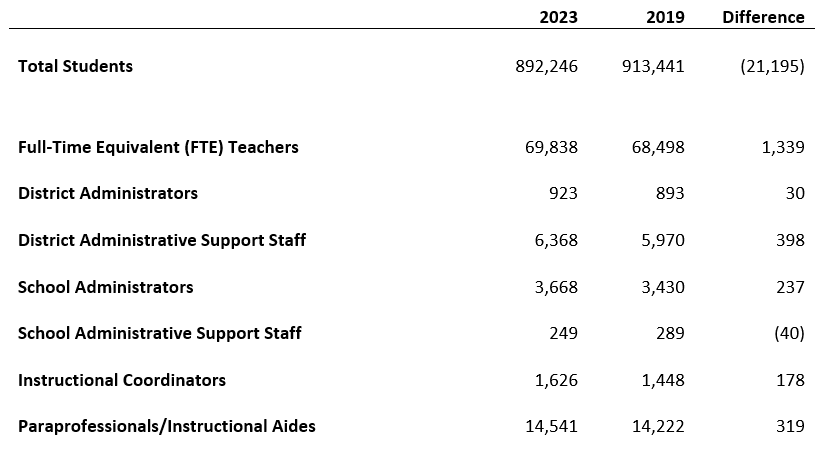
The above table has student and staff numbers for school year 2018–19 (pre-pandemic) and 2022–23 (last year). Overall, Missouri enrollment, including pre-K, fell by over 21,000 students, a trend that has been in the works for about a decade and has been much discussed on this blog. At the same time, though, Missouri school districts added over 1,300 teachers, almost 450 district administrators and staff, and about 200 school administrators and staff. Adding teachers while enrollment declined caused the number of students per teacher to fall below 13 (to 12.8) for the first time in at least 25 years. I understand why teachers prefer smaller class sizes. But these are very expensive decisions.

We are already hearing calls for the state to make up for the federal stimulus dollars that have run out. Maybe we should be asking some questions about spending decisions at the same time.


About the Author

Before joining the Show-Me Institute, Susan Pendergrass was Vice President of Research and Evaluation for the National Alliance for Public Charter Schools, where she oversaw data collection and analysis and carried out a rigorous research program. Susan earned a Bachelor of Science degree in Business, with a concentration in Finance, at the University of Colorado in 1983. She earned her Masters in Business Administration at George Washington University, with a concentration in Finance (1992) and a doctorate in public policy from George Mason University, with a concentration in social policy (2002). Susan began researching charter schools with her dissertation on the competitive effects of Massachusetts charter schools. Since then, she has conducted numerous studies on the fiscal impact of school choice legislation. Susan has also taught quantitative methods courses at the Paul H. Nitze School for Advanced International Studies, at Johns Hopkins University, and at the School of Public Policy at George Mason University. Prior to coming to the National Alliance, Susan was a senior policy advisor at the U.S. Department of Education during the Bush administration and a senior research scientist at the National Center for Education Statistics during the Obama administration.

Similar Stories

Support Us

Headline to go here about the good with supporting us.

Donate
Man on Horse Charging


