Kansas City Quinton Lucas recently tweeted out some charts regarding policing that need to be fact checked. While the Kansas City police are governed independently of city hall, the mayor not only oversees city funding of the police department, but every sitting mayor is automatically a member of the board that governs the police department.
The mayor is not a small player in Kansas City policing. As I argued in 2018, “No Missourian has more power over policing in Kansas City than the mayor,” so it’s a matter of concern when the mayor is promulgating incorrect numbers.
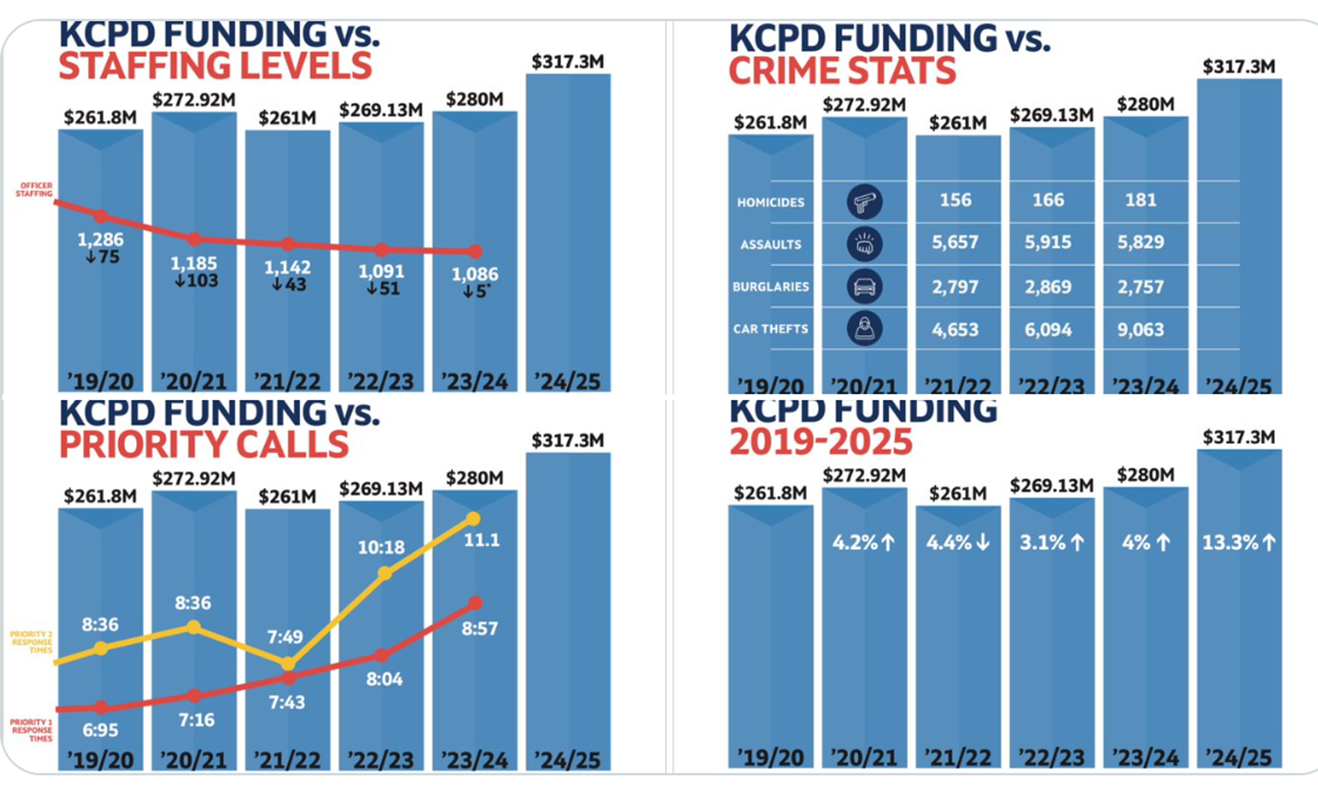
First, note that the blue columns in each chart seem to show police funding. The labels in the bottom show two years because the city’s fiscal year runs from May 1 to April 30 the following year. But the totals do not match police funding in the city’s annual reports. No explanation for the discrepancy was given.
Kansas City Councilmember (and former Show-Me Institute intern) Nathan Willett issued his own tweet regarding the mayor’s numbers, pointing out that a slightly different version of the slide failed to adjust for inflation. Were the numbers so adjusted, he pointed out, the chart would show Kansas City has yet to get back to pre-pandemic police funding levels.
One of the slides details crime numbers each year, such as homicides. Assuming that these depict calendar year crimes, as opposed to the fiscal year spending numbers on which they are superimposed, they still don’t match police crime stats.
The most embarrassing slide is the one examining priority call times. I wasn’t able to quickly find the numbers they refer to, but the times on the line chart are clearly wrong. The Priority 1 Response Times (in yellow) can’t be both 8:36 in ‘19/20 and in ‘20/21, because they are placed in different places on the line graph. And the 6:95 listed in the Priority 2 Response Times (in red) isn’t even a time.
I asked Mayor Lucas for the source of the information on the chart after the Public Safety Committee meeting on Tuesday night. He told me to file an open records request with his office. In Kansas City, that seems a polite way of saying “get lost.”
I don’t know the purpose these charts are meant to serve. But they don’t reflect a command of the facts on this issue.