An Ever-changing Landscape

Education |
By Susan Pendergrass | Read Time 2 minutes minutes

This fall, Missouri public school districts scrambled to create plans to deliver education to families that needed virtual instruction and families that needed in-person instruction. They surveyed parents and let them pick one or the other. They tried opening buildings for the youngest students only.

Then COVID exploded, and many of those plans became irrelevant. As we head into the holidays, almost one quarter of Missouri public school districts have gone back to the fully remote mode of last spring’s shutdown. And most districts that are continuing to operate in-person are very small, such that fewer than 74,000 of the nearly 870,000 Missouri public school students, or around 8 percent, are still learning completely in person, while over one quarter of Missouri students are now in districts that are virtual only.
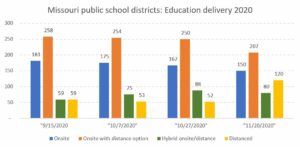
What I (and just about every parent) find most disturbing is how the numbers keep changing. In just two months, dozens of districts have switched from one mode to the other.

Parents have a right to be frustrated, and students have a right to gain a grade level of learning this year. How likely is the latter? The Missouri Legislature should be making immediate plans to make sure that every Missouri public school student has access to a virtual or in-person education of their choice. It’s time to stop forcing families to constantly adjust and have at least some state education funding available so everyone can find long-term solutions.

About the Author

Before joining the Show-Me Institute, Susan Pendergrass was Vice President of Research and Evaluation for the National Alliance for Public Charter Schools, where she oversaw data collection and analysis and carried out a rigorous research program. Susan earned a Bachelor of Science degree in Business, with a concentration in Finance, at the University of Colorado in 1983. She earned her Masters in Business Administration at George Washington University, with a concentration in Finance (1992) and a doctorate in public policy from George Mason University, with a concentration in social policy (2002). Susan began researching charter schools with her dissertation on the competitive effects of Massachusetts charter schools. Since then, she has conducted numerous studies on the fiscal impact of school choice legislation. Susan has also taught quantitative methods courses at the Paul H. Nitze School for Advanced International Studies, at Johns Hopkins University, and at the School of Public Policy at George Mason University. Prior to coming to the National Alliance, Susan was a senior policy advisor at the U.S. Department of Education during the Bush administration and a senior research scientist at the National Center for Education Statistics during the Obama administration.

Similar Stories

Support Us

Headline to go here about the good with supporting us.

Donate
Man on Horse Charging