

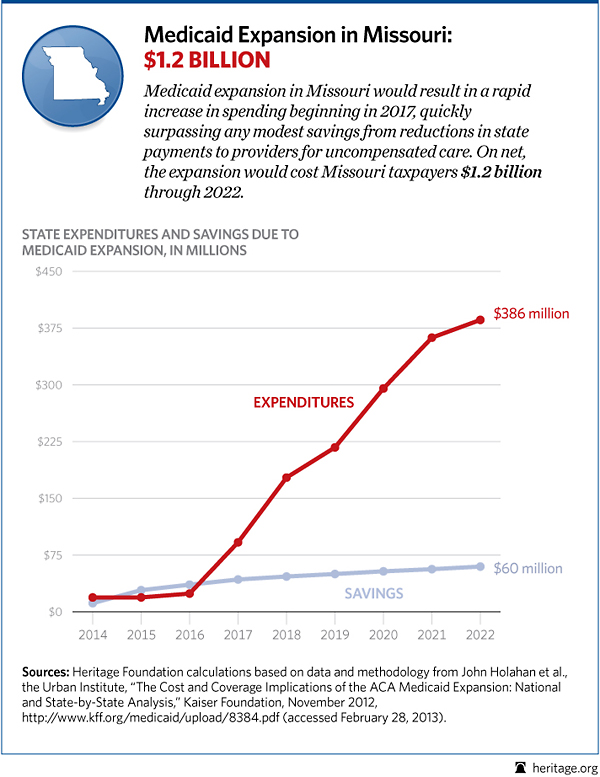
Earlier this month, the Heritage Foundation built and published a chart that ran out the direct costs of a Medicaid expansion with the “savings” the state could expect from now until 2022. This chart does not include the $1.6 billion in costs associated with the expansion’s so-called “woodwork effect,” whereby those currently eligible for the existing Medicaid program but not yet enrolled would become enrolled as a result of the Medicaid expansion. That fact makes this chart essentially a best-case cost-benefit scenario for a program whose costs, again, have not really been engaged by Medicaid expansion proponents. “No plan” for those costs is not good enough, as this chart bears out.
Economy
|
By
Patrick Ishmael
|
Read Time 1 minute
About the Author
Patrick Ishmael
Patrick Ishmael is the director of government accountability at the Show-Me Institute. He is a native of Kansas City and graduate of Saint Louis University, where he earned honors degrees in finance and political science and a law degree with a business concentration. His writing has been featured in the Los Angeles Times, Weekly Standard, and dozens of publications across the state and country. Ishmael is a regular contributor to Forbes and HotAir.com. His policy work predominantly focuses on tax, health care, and constitutional law issues. He is a member of the Missouri Bar.
Similar Stories
Economy
|
ARTICLE
|
Massachusetts Joins NYC and KC in Shifting Fees to Landlords
By Scott Tanner
|
Read Time 3 minutes
Accountability
|
ARTICLE
|
Most Teachers Don’t Like Equitable Grading Practices Either
By Scott Tanner
|
Read Time 2 minutes
Budget and Spending
|
ARTICLE
|
A Free-Market Guide to Zoning with David Stokes
By Susan Pendergrass
|
Read Time 22 minutes



