
Every year, the policy journal Education Next polls a representative sample of Americans about their views on education issues. Their 10th annual poll was just released this week and has several interesting data points.
A few highlights:
- 55% of Americans give their local public school an A or B grade, but only 25% of Americans give U.S. public schools as a whole an A or a B.
- Without prompting, 61% of Americans think that we should spend more on public schooling. When given the actual amount that their local school spends, that drops to 45%.
- Opinions on Common Core are evenly split, with 42% of Americans supporting it and 42% opposing.
- 28% of Americans support teacher tenure, and 54% oppose it.
- 69% of Americans support annual standardized testing of students
The first four findings didn’t really surprise me. The twin phenomena of liking your local school but disliking schools as a whole and thinking that your local school needs money until you’re told how much it spends have been documented by EdNext and others for years now. The Common Core has been in freefall, so that wasn’t unexpected either. Teacher tenure remains predictably unpopular.
I was surprised, though, at the durability of opinion on the value of standardized testing. Sixty-nine percent is strong support, and I would have thought with the unpopularity of the standards that many of the tests are based on that would have been a drag on opinion on the tests themselves. It looks like that isn’t the case!
What interested me most as a school choice advocate was public opinion about school choice issues. The poll asked questions about charter schools, vouchers, and tuition tax credits, and the findings might surprise you.
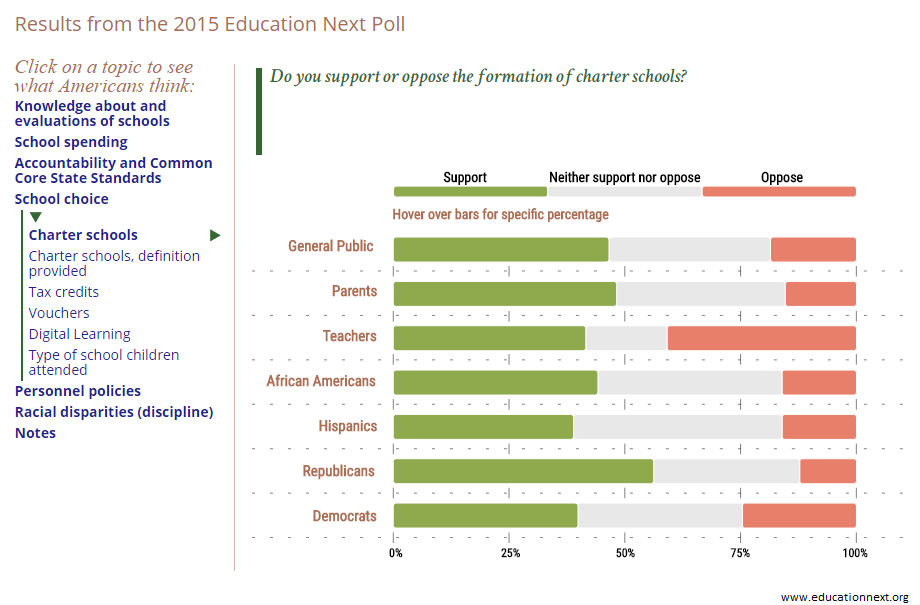
On charters, overall public opinion is 51% pro and 28% against. When observed by party affiliation, we see Republicans more likely to support charters (60% Pro and 21% Against) than Democrats (45% Pro and 33% Against).
Vouchers are, on average, less popular than charter schools, but interestingly, enjoy more support from Democrats than Republicans. Overall opinion (for a universal voucher program that all students would be eligible for) is 45% pro and 44% against with Democrats splitting 49% pro and 39% against and Republicans splitting 41% pro and 49% against. When the question is asked about a voucher program targeted to low-income students, the program becomes even less popular, with overall opinion 37% pro and 48% against (with Democrats 42% pro and 43% against, and Republicans 31% pro and 54% against).
Finally, and perhaps most interestingly for those of us in a state with a Blaine Amendment, tax credit scholarships were more popular than either vouchers or charter schools. Fifty-three percent of Americans support tax credits while only 29% oppose them. The partisan split remains though, with Democrats supporting more than Republicans. Democrats split 57% pro and 26% against while Republicans split 49% pro and 33% against.
It is always good to take the nation’s temperature on issues of schooling. School choice supporters in particular should take a moment to reflect on these findings. Perhaps supporters (and opponents) aren’t who we think they are.




