
It’s about the third Monday since nearly every school building in the United States was closed, and yet most large school districts are still struggling to generate any learning at all for their students. We’re all learning as we go here, but there is an enormous risk of student learning loss if districts don’t start rolling out more solid guidance.
The Center for Reinventing Public Education (CRPE) at the University of Washington has created a database of the COVID-19 plans being developed by 82 large districts. Here are the plans thus far.
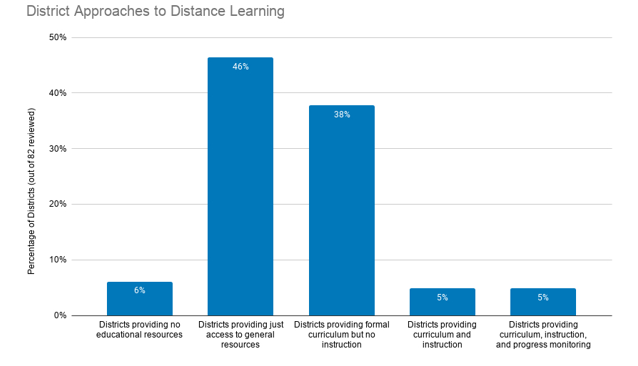
St. Louis City and Kansas City are in the second column. They have some links to additional resources on their websites and they are mailing homework assignments to their students or distributing them with student meals. They plan on having video instruction in the “coming weeks,” and they’re developing calendars to pace assignments over 10 days. In other words, much of the burden falls on parents to figure out what to do.
We need every Missouri school district to be answering these big questions: How will students receive instruction? Will their assignments be graded? Will students automatically advance to the next grade? Will high school seniors automatically graduate? Will there be summer school to make up for lost days? If there is little or no online instruction offered, what should teachers be doing?
Fortunately, there are plenty of good examples for districts to follow. Success Academy, a highly effective charter school network in New York City, has teachers calling each of their students at least twice per day. They have provided plain answers to parents’ most pressing questions. The Springfield Public School District in Missouri is giving parents some solid guidance and has set up an online learning system for parents. There are countless examples of varying quality. Sadly, the most vulnerable students are the ones who will really fall through the cracks if we don’t demand high-quality, engaged solutions from each and every school district.




