

Marc Joffe, Director of Policy Research for the California Policy Center, has rated the largest 116 U.S. cities according to their financial health and published the ratings in The Fiscal Times website. Missouri’s appearances on the list are not a source of pride.
The study’s methodology rates five things: spending, long-term obligations, pension contributions, and changes in local unemployment and property values. Of the 116 cities, Irvine, California, performs the best. New York and Chicago come is 115th and 116th, respectively. Kansas City and St. Louis, with populations much smaller, rank 101st and 112th, respectively.
What really hurt Kansas City’s score were its long-term obligations, or debt, which stands at 170% of total revenues. In St. Louis the debt is over 200% of total revenues. According to a 2013 Show-Me Institute study (see Figure 9) Kansas City has $296.24 in debt per person while St. Louis has $328.16 per person—the most of our Midwest peer cities.
This is nothing new. In March 2015, WalletHub released a study in which Kansas City ranked 61st out of 65 cities in terms of spending efficiency. The Mayor’s own Citizens Commission on Municipal Revenue 2012 report cites high debt as a problem and offers, “Because current debt levels are high compared to peer cities, the impact on the City’s credit rating from issuing additional and significant levels of debt must be of primary concern.” The report showed that Kansas City had the highest debt per capita of ALL the peer cities they considered, including St. Louis, and well over the national average (see Page A-17).
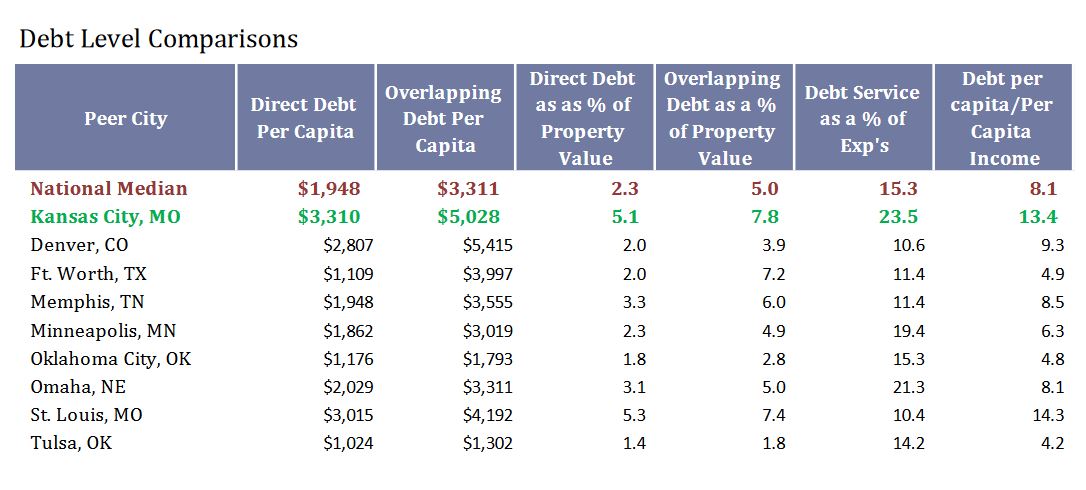
A Moody’s Investor Services report from January 2016 indicates that Kansas City’s direct net debt per capita is $3,675. Not only is this higher than any of Kansas City’s peer cities, but it is $500 more per person than St. Louis and $1,400 more per person than Denver, the 2nd- and 3rd- highest indebted peer cities!
Despite this very high debt level, Kansas City leadership is seeking public support for $800 million in additional debt to provide for the infrastructure maintenance the city has neglected for years. This would only exacerbate the city’s financial challenges. The problem is not that the city brings in too little revenue—Kansas City is a high-tax city. The problem is that the city seems to waste this money on economic development schemes that do not accrue to its financial benefit, while neglecting basic services. The solution to this problem is not more of the same.




