
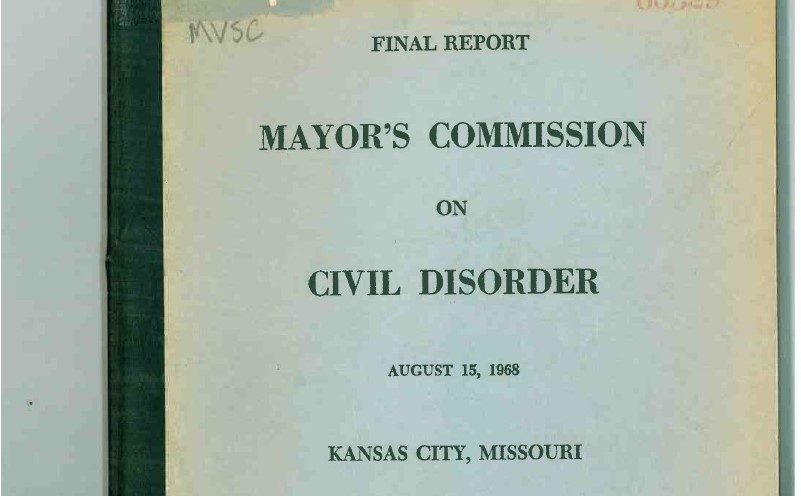
Immediately following the assassination of Dr. Martin Luther King, Jr. and riots in Kansas City, Mayor Ilus “Ike” Davis appointed the Mayor’s Commission on Civil Disorder to examine events and suggest changes. Reading the commission’s report 50 years to the week after it was issued is an unpleasant reminder of how little progress has been made.
The report examined “the severe civil disturbance that occurred in Kansas City during the week of April 8, 1968 and [made] a report to the people of Kansas City.” Among other things, the report contained recommendations for avoiding future riots and “for the establishment of harmonious relations among the people of this city.”
One of the areas examined was Kansas City’s police—their number, recruiting, training, and tactics. At the time of the report, Kansas City had 932 police officers and was facing reductions. On page 48 the report offers:
Instead of its police force being reduced, this city needs a total of at least 1,500 police officers. Even the existing statute contemplates two police employees for each 800 persons in the population. Since 1961 Kansas City’s population has increased by approximately 15%, and its land area has been nearly doubled by annexation. Expected police service has increased by 58%, but the number of law enforcement personnel has remained approximately the same as it was in 1961.
The commissioners’ call for more police to reduce crime is borne out by subsequent research. Yet Kansas City today has 1,283 sworn law enforcement officers, down 121 from the 1,404 officers they had in 2010. The city never achieved the 1,500 mark recommended by the commission’s report. Nor has the city successfully adopted the commission’s recommendation to rely more heavily on foot patrolmen—but that may be a function of not having enough officers.
Based on 2017 data, Kansas City has the sixth-highest homicide rate in the United States per 100,000 population. Based on FBI statistics, of the ten cities with the highest homicide rates, Kansas City has the fewest officers per 10,000 population.
A years-long, nation-leading spike in the number of homicides is arguably as “severe” a “civil disturbance” as one can imagine. Numerous factors are causally linked to crime, including education, poverty, and income inequality. Yet when it comes to the one aspect of public safety that policymakers can control, policing, Kansas City has fallen short of its 1968 goals.




