
The Missouri Legislature is hard at work on the budget for the next fiscal year. One of the biggest components of the budget is K-12 public education. I think it’s helpful to periodically pause and take a look at what is actually spent on education to see if it’s too little or too much. Most people have no idea how much is even spent, and if they think they know, they underestimate the dollar amounts. So, here’s the truth.
The following numbers are from the Department of Elementary and Secondary Education’s (DESE) Missouri Comprehensive Data System (MCDS). The file is called “Finance Data and Statistics for All Districts” and it can be found here.
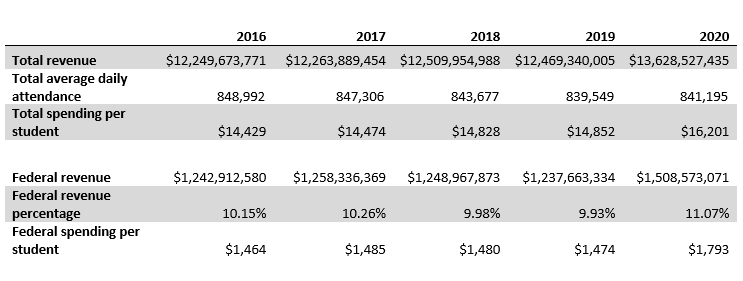
Last year, when every school in the state shut down and many were able to offer little more than homework packets and buses stopped running and buildings were closed, Missouri public school districts spent just over $16,000 per student. That sounds a lot like the tuition at a fancy private school.
Of course, we did get about $300 million in federal stimulus funds for public education, but that only explains the $330 difference in federal spending per student between 2019 and 2020. State and local spending also increased. In 2021, Missouri is set to receive an additional $2.8 billion in federal stimulus, or over $3,000 for every student in the state. Does that mean that spending per student will be $19,000 in 2021? Will it be more?
In addition to working on the budget, the Senate is set to debate whether donations to scholarship-granting organizations should continue to be treated as tax deductions or if the donor should get a full tax credit. Giving donors a full tax credit would greatly incentivize donations to these scholarship organizations. The tax-credit-funded scholarships would give families money to customize their children’s education outside of their assigned public school. The defenders of the status quo—superintendents, school boards, and teacher union leadership—will undoubtedly say we can’t afford it. In light of the numbers above, does that seem true?




