

The first report from the Missouri School Improvement Program 6 (MSIP 6) was released recently, providing data on how each school and district in Missouri performed. Evaluation systems, such as MSIP, typically measure performance and growth. Most of the public conversation is about performance, as we regularly see discussions about the percentage of students who are “proficient” or “advanced.” While performance is a really useful metric, growth is also important. And in the MSIP 6 results, the extremely high growth rates in both math and English/language arts (ELA) for charter school students were notable.
Before delving into the growth results, it is important to understand the applicable terminology. There are two different subgroups for comparing math and ELA scores: “all students” and “selected groups.” All students is self-explanatory, but selected groups are comprised of students that have been historically lower performing—low-income students, Black students, Hispanic students, students with disabilities, and English-language learners.
The latest MSIP 6 results display growth statistics for 1,672 different traditional and charter schools, with charters comprising 57 (or 3.4%) of the total. Despite being such a small percentage of the overall sample, charter schools held at least 20 percent of the top ten, twenty-five, and forty spots in each category.
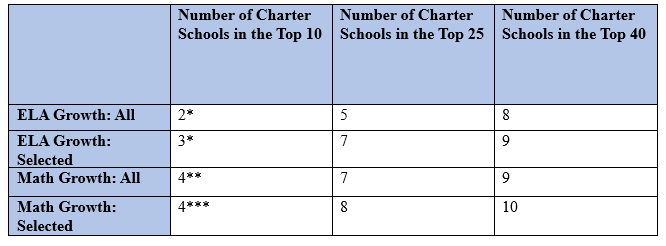
*KIPP Wisdom Academy STL was #1 in ELA Growth for All and Selected Groups
**Four of the top six were charter schools
***The top three, and four of the top five, were charter schools
While charter schools are greatly overrepresented in the top scorers for all students, they are even more so in selected groups. In areas with historically lower-performing students, charter schools have narrowed some of the traditional gaps. Growth may also be a better measure than absolute performance in some of these areas that have struggled historically. It would be unreasonable to expect schools with many underperforming students to compete with high-performing districts overnight. But growth indicates that things are moving in the right direction and that the gap may eventually disappear.
Opponents of charter schools often point to their performance compared to state averages. Since Missouri’s charter schools predominantly serve higher percentages of disadvantaged students living in St. Louis and Kansas City, these comparisons are not very accurate indicators of charter school quality. In certain circumstances, growth can be a better measure. And, as we can see, charter schools seem to be getting something right on growth that traditional public schools can’t yet match. Charter schools have shown they certainly deserve a place (and an expanded one) in Missouri’s education sphere.