
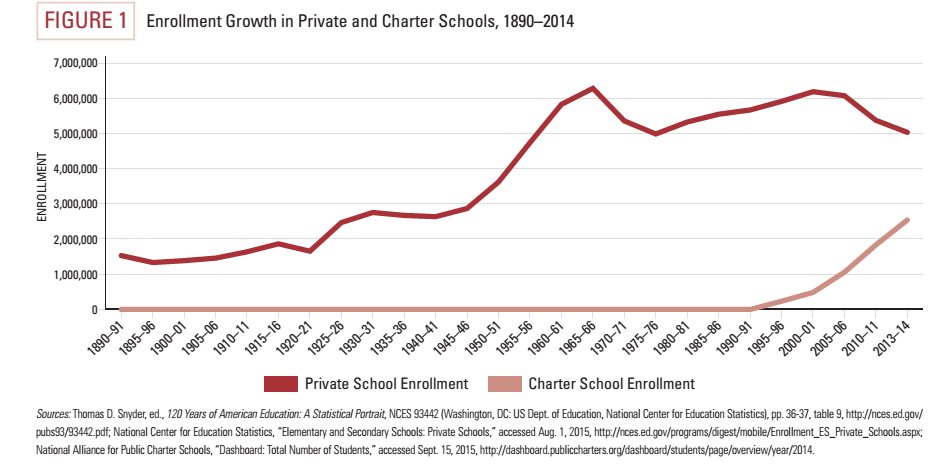
The past 40 years have seen a well-documented decline in Catholic school enrollment across the country. But what many people don’t know is that there has also been a decline in total private school enrollment—Catholic and otherwise—particularly in the last 15 years. The entire sector is shrinking.
In a new paper, Juliet Squire, Kelly Robson, and Andy Smarick look all the way back to the 1890s to track private schooling’s long rise to its peak in the mid-1960s and its decline to today. The trend line is shown in the graph above.
In recent years, numerous states have passed private school choice programs that have helped turn these trends around, at least locally. But even the growth in school choice programs has not been enough to stanch the decline.
Into that context jump Squire et al, documenting a new phenomenon called “Private School Management Organizations” (PSMOs). Much like Charter management organizations like KIPP or Green Dot work to help organize and supervise networks of charter schools, PSMOs like Wisconsin’s HOPE Christian Schools or Memphis’s Jubilee Schools work to help organize and supervise networks of private schools. These groups are organized around one of two major goals. Some are designed to shore up the finances and management of existing private schools and help put them on a sustainable long-term trajectory. Others are designed to help open and expand new private schools.
Charter management organizations have been extremely successful in spreading charter schooling nationwide. KIPP schools, for example, started in Houston in 1994 with only 47 students in one school. They now educate over 70,000 students in 183 schools in 20 states and the District of Columbia. It would be wonderful if private schools could learn from them.
Kansas City has the Strong City Schools and St. Louis has the ACCESS Academies, which are kind of proto-PSMOs, but private school leaders across the state could look to the examples Squire et al highlight and the lessons from nascent efforts to see how such organizations might help students looking for a private education in Missouri.
I worry that when the happy day comes that Missouri passes a school choice program, so many private schools will have closed that the options available to students will be limited. Clearly, help is needed to keep private schools alive until more sustainable support, in the form of vouchers, tax credit scholarships, or education savings accounts, arrive. PSMOs are one path to achieving that.




