For almost a year there have been dire discussions of a coming “fiscal cliff” in public education spending. What is this doomsday fiscal cliff you might ask, and why is it going to happen? Simply stated, it is the expiration of federal stimulus funds that were sent to states during the COVID-19 pandemic. The pandemic emergency has ended and, therefore, at some point, so will the emergency spending. Or, as described by the chairman of the Missouri Board of Education in a recent article, “you have a lot of federal authority deleted.” Huh? So, naturally, the drumbeat has begun for big asks of lawmakers to appropriate state funds that will make up the difference.
Let’s look at this with a clear head. The chart below shows Missouri state and federal revenue for public education, adjusted for inflation, from before the pandemic through the recently approved budget for the 2024–25 school year. In 2017–18, there were just under 920,000 students in pre-K through 12th grade in Missouri and the state legislature appropriated a total of $5.8 million (2023 dollars) from the general revenue fund and other state funds. The federal government kicked in another $1.3 million, largely for the Title I program for low-income students, the IDEA program for students with disabilities, and the school lunch program. Last year, even after the recovery from the pandemic enrollment drops, we had about 25,000 fewer students—a trend that is expected to continue. Yet, the legislature’s appropriation was about $500 million more than seven years ago.
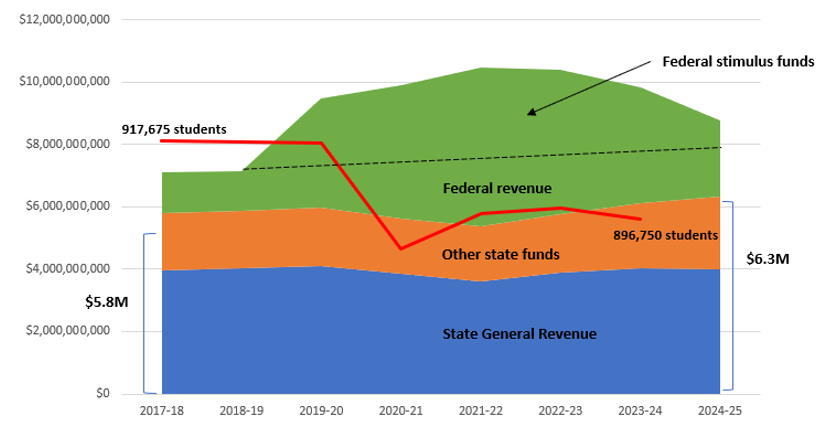
The cliff is in that green hump at the top of the graph. Like a hike in the mountains, if you do a lot of climbing, you’re going to have to descend at some point to get back to your car.
So, is it obvious that we need a special session to get a “mother of all supplemental budgets” for education? Only if you believe that spending can only ever go up. Missouri, like many states, has a persistent trend of declining enrollment. Is it reasonable to think that we can only ever consider level or increased spending on public education?