
The Charter School Discipline Problem that Isn’t

Education |
By Michael Q. McShane | Read Time 2 minutes minutes

Mark Twain is credited with the saying, “It ain’t what you don’t know that gets you into trouble. It’s what you know for sure that just ain’t so.”

For years now, critics (and even some supporters) have known for sure that charter schools had harsher discipline policies than traditional public schools and suspended or expelled students at much higher rates. According to new research from Nat Malkus of the American Enterprise Institute, that just ain’t so.

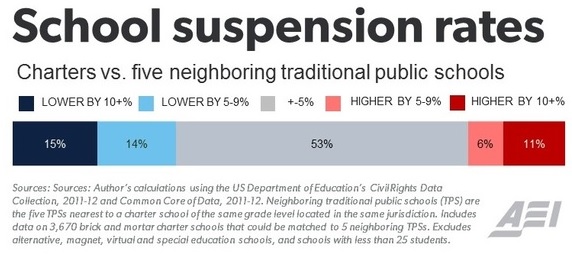
Malkus used data on school suspension rates collected by the federal government to compare charter schools to the traditional public schools that surround them. As Malkin's graphic (above) shows, in most cases, there is no substantial difference in the rate of suspensions between traditional public schools and charter schools. In fact, while 17 percent of charter schools do see rates higher than neighboring public schools, 29 percent see rates that are significantly lower.

It’s time we put to bed the idea that charter schools are draconian institutions where the joy of learning is taken from students and where harsh punishment is meted out for the most minor of infractions. The data do not back that story up.


About the Author

Michael Q. McShane is Senior Fellow of Education Policy at the Show-Me Institute.  A former high school teacher, he earned a Ph.D. in education policy from the University of Arkansas, an M.Ed. from the University of Notre Dame, and a B.A. in English from St. Louis University. McShanes analyses and commentary have been published widely in the media, including in the Huffington Post, National Affairs, USA Today, and The Washington Post. He has also been featured in education-specific outlets such as Teachers College Commentary, Education Week, Phi Delta Kappan, and Education Next. In addition to authoring numerous white papers, McShane has had academic work published in Education Finance and Policy and the Journal of School Choice. He is the editor of New and Better Schools (Rowman and Littlefield, 2015), the author of Education and Opportunity (AEI Press, 2014), and coeditor of Teacher Quality 2.0 (Harvard Education Press, 2014) and Common Core Meets Education Reform (Teachers College Press, 2013).

Similar Stories

Support Us

Headline to go here about the good with supporting us.

Donate
Man on Horse Charging


