

A recent survey conducted by ALG Research and Public Opinion Strategies of 2,500 registered voters has some interesting items for legislators and the Missouri Department of Elementary and Secondary Education (DESE). Here’s a summary of the “Bottom Line”:
There is high, and deep, support for student testing in K-12 public education. As a result, elected officials across the country should ignore the noise and instead focus on what the lion’s share of voters are saying – test students each year to assess progress in reading, writing, and math, and look for opportunities to improve the way states can measure student progress in the future. Voters want testing to be fixed, not ended.
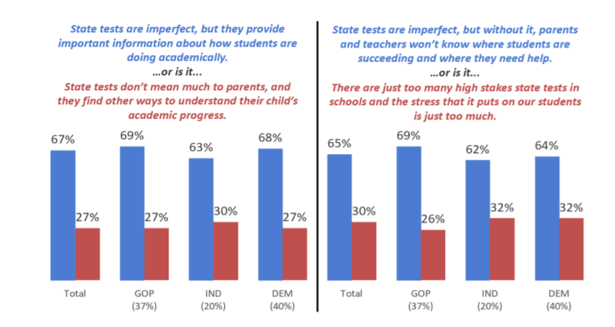
Overall, things are not looking good. Almost half (44 percent) of all voters in this survey say that the public schools in their state are on the wrong track and more than two thirds (68 percent) of parents believe that their children started the school year behind. But people don’t want to gloss over what is happening. In fact, nine in ten respondents said that testing students every year in reading, writing, and math is important.
Even when presented with arguments against testing, respondents overwhelmingly believe it is necessary:
DESE is preparing to launch the sixth version of the Missouri School Improvement Program (MSIP), which is used to hold schools and districts accountable for their performance. MSIP 6 is likely to be even less grounded in assessments than MSIP 5, given that just one half on one page in the accompanying 22-page document deals with academics.
Legislators would be wise to remember that parents and voters want real accountability. We can handle the truth, even in times of dismal performance. In fact, we welcome it.




