
This Is Not a Drill

Education |
By Susan Pendergrass | Read Time 2 minutes minutes

As you may have read here many times, Missouri’s public school enrollment is shrinking. A big part of the reason for this is declining birth rates. A recent report released by the Western Interstate Commission for Higher Education (WICHE) projects that Missouri will have its largest class of high school graduates this school year—spring 2025—at 68,656 graduates. That includes 63,349 public school high school graduates and 5,307 private high school graduates. By 2041, WICHE projects that Missouri will have just 58,880 total high school graduates, with 54,401 coming from public schools and 4,776 from private schools.
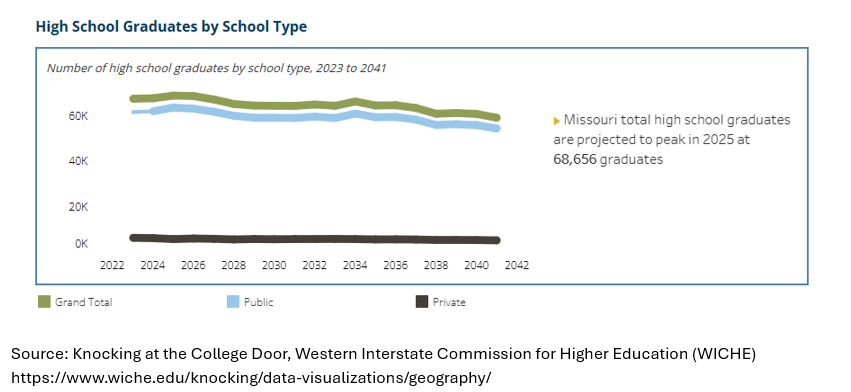
Now that we have reached the (projected) enrollment peak and are heading down the cliff, Missouri needs to begin considering the implications for higher education and the workforce. First, the state should focus on the cost and access of public colleges and universities. Second students not planning on attending college should have access to career-building skills and certificates while still in high school. Finally, and most importantly, every Missouri high school graduate should leave school college or career ready.

We’ve known about these trends for a while, but there’s still time to adjust to our new enrollment reality if we make needed changes now. We’ll see if Missouri lawmakers actually follow through.


About the Author

Before joining the Show-Me Institute, Susan Pendergrass was Vice President of Research and Evaluation for the National Alliance for Public Charter Schools, where she oversaw data collection and analysis and carried out a rigorous research program. Susan earned a Bachelor of Science degree in Business, with a concentration in Finance, at the University of Colorado in 1983. She earned her Masters in Business Administration at George Washington University, with a concentration in Finance (1992) and a doctorate in public policy from George Mason University, with a concentration in social policy (2002). Susan began researching charter schools with her dissertation on the competitive effects of Massachusetts charter schools. Since then, she has conducted numerous studies on the fiscal impact of school choice legislation. Susan has also taught quantitative methods courses at the Paul H. Nitze School for Advanced International Studies, at Johns Hopkins University, and at the School of Public Policy at George Mason University. Prior to coming to the National Alliance, Susan was a senior policy advisor at the U.S. Department of Education during the Bush administration and a senior research scientist at the National Center for Education Statistics during the Obama administration.

Similar Stories

Support Us

Headline to go here about the good with supporting us.

Donate
Man on Horse Charging