
For many years, both Atlas Van Lines and United Van Lines have compiled data on the number of moves into and out of states. Over the past several years Missouri has seen more households moving out than moving in. Based on the van lines’ recent reports, that all-too-familiar story continued in 2016.
Between January 1 and December 31 of 2016, Atlas reports that 1,062 households left Missouri and 989 households moved in. A similar tale is told using the data from United Van Lines: Of the 4,362 total moves made in 2016, 2,256 were outbound and 2,106 were inbound. Although the numbers are close, it is still true that on net more Missouri households are deciding to leave the state.
The United study is valuable because it breaks down the total number of into reasons for moving, and they disaggregate the data by income and age. In terms of reasons for moving, not surprisingly the vast majority of households move because of jobs. Sixty-two percent of those moving out cited job-related reasons, and 60 percent of those moving into the state did so because of work. The second highest category was “family,” with about 20 percent inbound and outbound choosing that reason for the move.
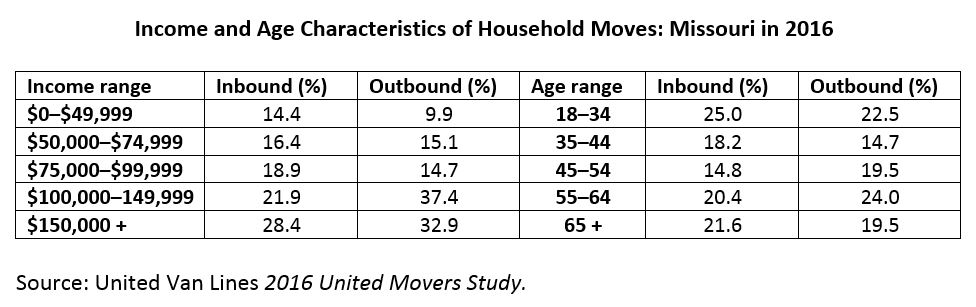
The income and age characteristics of those moving are more revealing. The table below breaks down of inbound and outbound moves by income (left-hand side of table) and age (right-hand side of table). The data suggest that those in the highest income ranks—incomes exceeding $100,000—were, in 2016, net out-migrants: more left Missouri than moved in. This accords with earlier results: Michael Rathbone and I found that, based on IRS data, those who moved out of Missouri tended to be higher income individuals.
When age is the common denominator, it appears that in-migration in 2016 is concentrated in the younger age groups (those younger than 44). Of those between the ages of 45 and 64, prime wage-earning years according to a New York Federal Reserve study, there was a net migration out of Missouri, however. And for the 65-plus age group, it is essentially a wash: just about as many moving out as moving in.
This 2016 data builds on the prevailing story that Missouri’s residents continue to reveal their preferences and, on net, seek other, more attractive economic environments.