
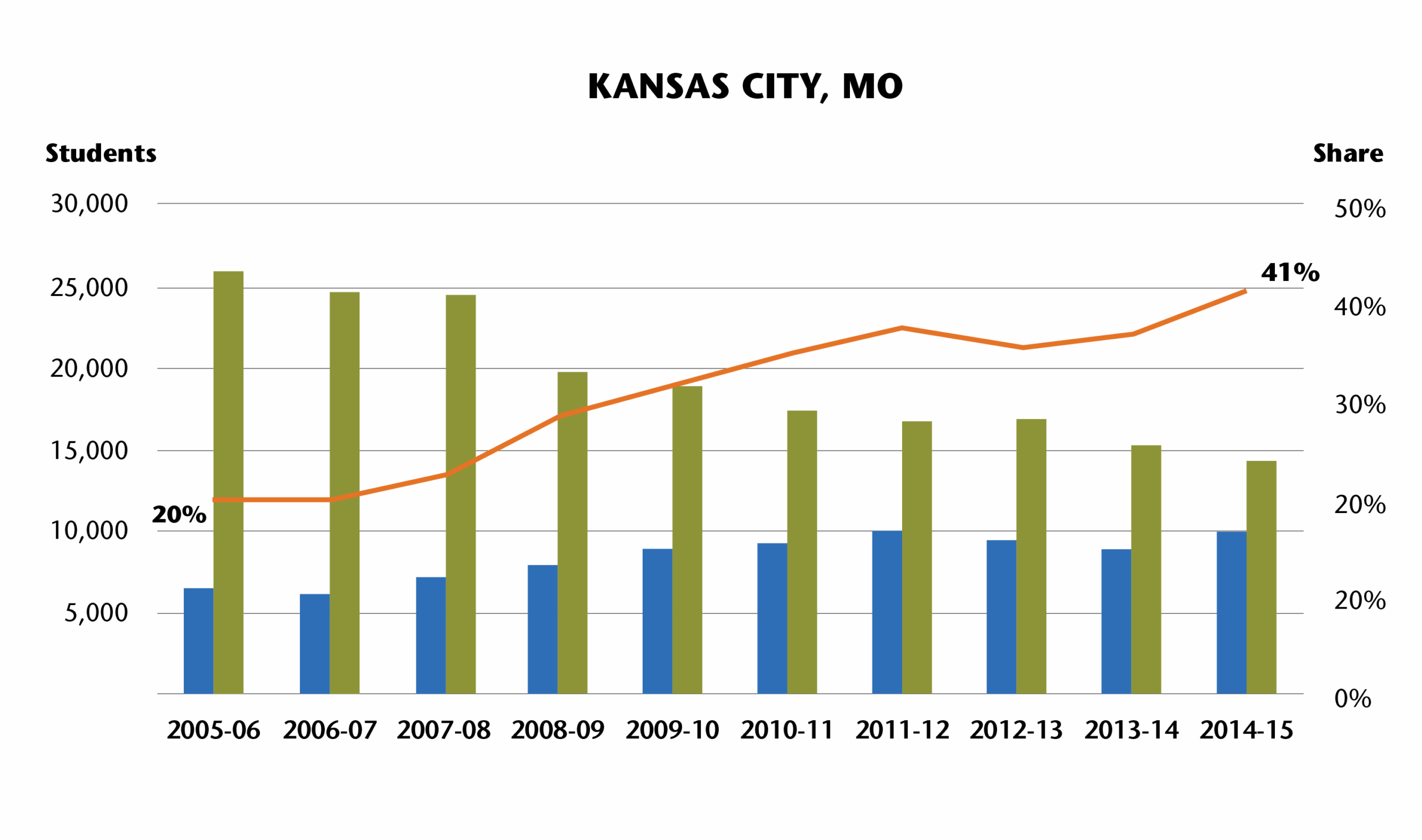
Today, the National Alliance for Public Charter Schools released a report on the market share of charter schools in cities and school districts across the country. When measured by percentage of public school enrollment, Kansas City is #5 in the nation, at 41 percent of all students.
|
Rank |
School District |
State |
Charter Students |
Non-charter Students |
Total |
Enrollment Share |
|
1 |
Orleans Parish School District |
LA |
42,860 |
3,340 |
46,200 |
93% |
|
2 |
Detroit City School District |
MI |
52,420 |
47,040 |
99,460 |
53% |
|
3 |
School District of the City of Flint |
MI |
5,660 |
6,490 |
12,150 |
47% |
|
4 |
District of Columbia Public Schools |
DC |
37,680 |
47,550 |
85,230 |
44% |
|
5 |
Kansas City, Missouri School District |
MO |
9,980 |
14,230 |
24,210 |
41% |
The trend line (see the graph above) is also significant. Charter enrollment is going up, and traditional public enrollment is going down.
A few quick reactions:
1. The narrative, at least coming from the Kansas City School District, is that the district is improving. Graduation rates are up, and test scores show that the district might be on the path to full accreditation. If that’s true, it would stand to reason that charter schooling is helping (or at the very least not hurting) the Kansas City public schools.
2. It is important to remember that the city and the school district are not coterminous; in fact, 16 different school districts cover some part of Kansas City proper. Why charter schools are only allowed in one subsection of the city, especially when there is such clear demand for them, is beyond me.
3. This report does highlight just how small the Kansas City School District has become. I don’t think a lot of people realize this, but there are only 14,230 students enrolled in the Kansas City public schools. When you think that Omaha’s main school district has 51,000 students, Des Moines’ has 33,000, and even Little Rock’s has 25,000, you realize just how much the district has shriveled up over the years.
Ultimately, Kansas City needs to have a conversation about what to do with the school district. If trends continue and more and more students attend charter schools, we have to think about transitioning the district from an institution that operates schools in addition to funding and regulating them to an institution that funds and regulates schools, but leaves operation up to others.




