
Where Are the Students?

Education |
By Susan Pendergrass | Read Time 1 minute minutes

In addition to declining enrollment, public education in Missouri has another serious problem—chronic absenteeism. Schools have been reopened for two years, but many students have not returned to the classroom with consistency. As pointed out in a new study by Thomas Dee of Stanford University, this post-pandemic chronic absenteeism threatens post-pandemic academic recovery.

Chronic absenteeism in this case means missing 10 percent or more of the school year—about 18 days in Missouri. Dee reports that from the school year before the pandemic (2018–19) to the year after (2021–22), Missouri’s chronic absenteeism nearly doubled, from 13 percent to 24 percent. That means nearly one quarter of our students, or just under 200,000 students, missed a potentially damaging number of days of school.

While Dee’s study only includes those two time periods, DESE data indicate that chronic absenteeism had already been on the rise in Missouri.
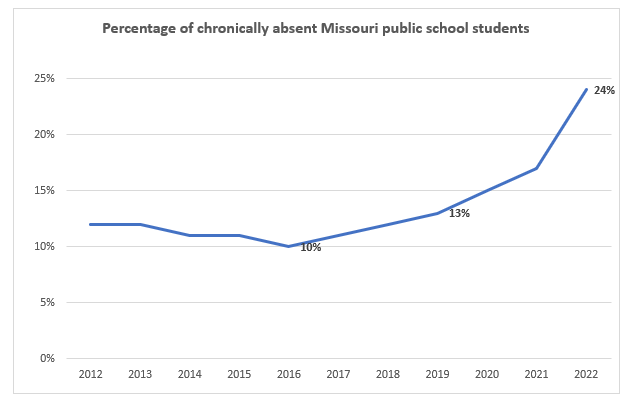
It’s unclear why absenteeism has been growing in Missouri, but it’s a serious problem. Missing a significant number of days can impact math and reading achievement, social–emotional development, and discipline. It is also associated with an increase in risky behaviors outside of school. Missouri leaders should be addressing this problem as the crisis that it is.


About the Author

Before joining the Show-Me Institute, Susan Pendergrass was Vice President of Research and Evaluation for the National Alliance for Public Charter Schools, where she oversaw data collection and analysis and carried out a rigorous research program. Susan earned a Bachelor of Science degree in Business, with a concentration in Finance, at the University of Colorado in 1983. She earned her Masters in Business Administration at George Washington University, with a concentration in Finance (1992) and a doctorate in public policy from George Mason University, with a concentration in social policy (2002). Susan began researching charter schools with her dissertation on the competitive effects of Massachusetts charter schools. Since then, she has conducted numerous studies on the fiscal impact of school choice legislation. Susan has also taught quantitative methods courses at the Paul H. Nitze School for Advanced International Studies, at Johns Hopkins University, and at the School of Public Policy at George Mason University. Prior to coming to the National Alliance, Susan was a senior policy advisor at the U.S. Department of Education during the Bush administration and a senior research scientist at the National Center for Education Statistics during the Obama administration.

Similar Stories

Support Us

Headline to go here about the good with supporting us.

Donate
Man on Horse Charging


